Stock Code: 831045
Industrial Automation & Intelligence Solutions
SUMMERY: Automation brochures make robotic welding look effortless: stable arcs, perfect beads, uninterrupted production. On real factory floors, however, robotic welding issues and challenges show up quickly—sometimes within the first production...
Automation brochures make robotic welding look effortless: stable arcs, perfect beads, uninterrupted production. On real factory floors, however, robotic welding issues and challenges show up quickly—sometimes within the first production shift.
Understanding these robotic welding issues and challenges is the difference between a robot that “works” and a system that truly replaces manual welding. This article looks at the technical side of welding automation: where problems actually come from, and what practical robotic welding solutions look like in real production environments.
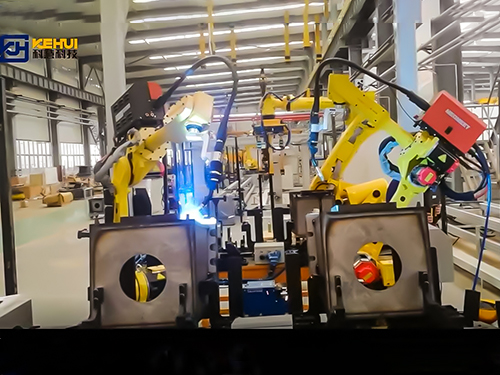
One of the most common robotic welding issues and challenges is unstable weld quality after initial commissioning. The robot repeats its path perfectly—but the weld bead varies.
Why?
Because welding is not just motion control. It is:
Arc energy management
Wire feed consistency
Contact tip wear
Base material variation
Heat accumulation over time
Many manufacturers assume these variables are “minor.” In reality, they are central. Without proper robotic welding integration, even high-end robots produce inconsistent penetration or spatter problems.
Effective robotic welding solutions begin with process validation, not robot programming.
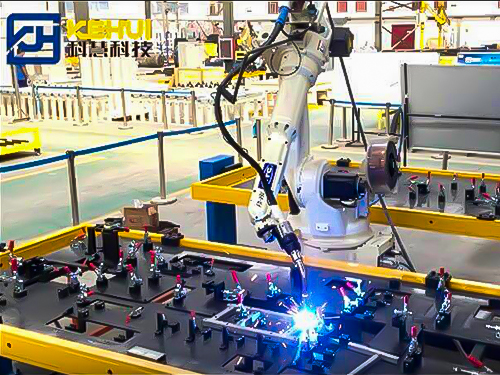
Ask experienced engineers about recurring robotic welding issues and challenges, and fixture design is almost always mentioned.
Common problems include:
Inadequate clamping force
Thermal distortion during long seams
Inconsistent root gap
Poor repeatability during multi-batch production
A robot cannot compensate for structural instability. That is why serious robotic welding integration starts with mechanical engineering.
Strong industrial robotics solutions treat fixture design and robot programming as one system—not separate steps.
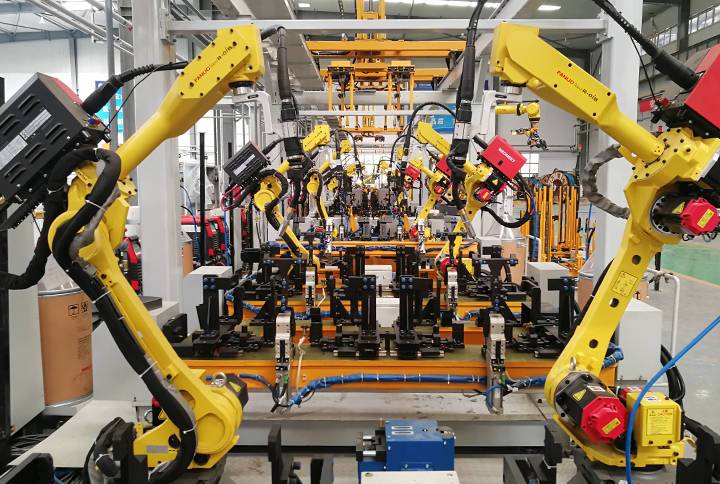
When welding thickness increases, complexity multiplies. Multi-pass welding introduces additional robotic welding issues and challenges:
Interpass temperature management
Layer sequencing logic
Torch angle adaptation
Travel speed optimization
In such cases, the robot is no longer just following a line—it is executing a thermal strategy.
This is where generic automation providers struggle. Advanced robotic welding solutions require deep understanding of metallurgy and arc behavior, not just robot code.
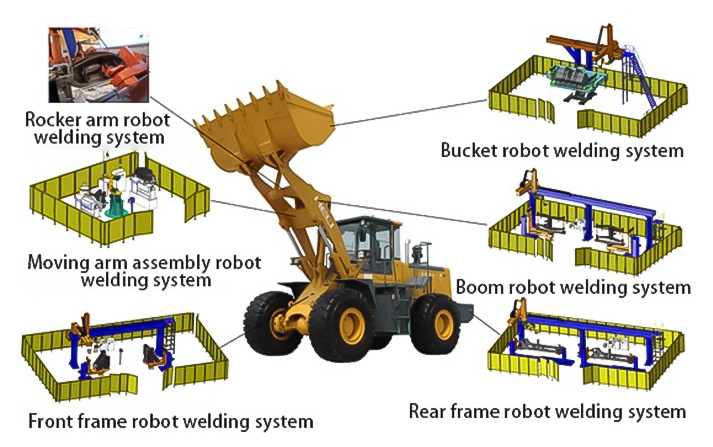
Another major category of robotic welding issues and challenges is seam variation. Even precision-machined parts have tolerance shifts.
Without adaptive systems:
Weld seams drift
Penetration becomes inconsistent
Rework rates increase
Modern industrial robotics solutions integrate:
Arc voltage tracking
Laser seam tracking
Vision-based positioning
Real-time parameter correction
A capable laser welding robot integrator understands that sensors are not add-ons—they are part of the welding logic.
True robotic welding integration combines hardware, software, and process correction into one architecture.
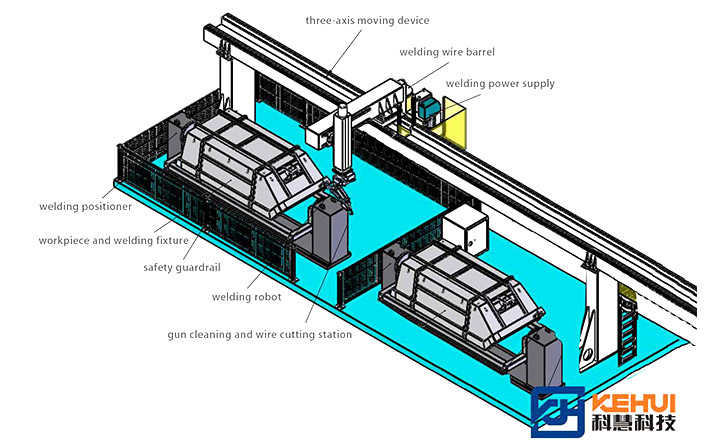
A robot without correct power source integration is incomplete.
Many robotic welding machine manufacturers provide solid hardware, but system performance depends on:
Communication protocols between robot and power source
Pulse waveform matching
Arc start reliability
Burn-back control
Poor coordination between robot controller and welding source is one of the most underestimated robotic welding issues and challenges.
Advanced robotic welding solutions treat the robot and power source as a synchronized unit—not independent devices.
Laser welding introduces a different layer of complexity.
A skilled laser welding robot integrator must manage:
Beam alignment precision
Reflectivity control
Shielding gas optimization
Thermal concentration effects
Unlike conventional arc welding, laser processes tolerate far less deviation. Therefore, robotic welding integration in laser applications requires extremely tight calibration and safety management.
Not all robotic welding machine manufacturers or integrators are equipped for this level of precision.
The true evaluation of industrial robotics solutions happens after six months of operation.
Key indicators include:
Stable weld quality across shifts
Predictable maintenance cycles
Minimal parameter drift
Clear documentation for process adjustments
Solving robotic welding issues and challenges is not about fixing isolated problems—it is about building systems that prevent them.
That requires experience.
Since 1994, we have focused exclusively on welding-centered robotic welding integration.
We are not simply one of many robotic welding machine manufacturers. We are automation system integrators delivering complete robotic welding solutions to manufacturers worldwide.
Our work includes:
Robotic arc welding workstations
Multi-station welding production lines
Structural steel welding automation
Custom industrial robotics solutions for heavy manufacturing
What makes our approach different:
We begin with process simulation and real weld trials
Fixtures are engineered alongside robot programming
Power sources are selected based on material behavior
Engineers travel on-site for installation, tuning, and operator training
Systems are tested under real production load—not just demonstration runs
We understand that most robotic welding issues and challenges do not appear in the showroom—they appear on the factory floor at 2 a.m. during peak production.
That is why our focus is not simply selling equipment. It is delivering stable, scalable welding automation systems that continue to perform long after handover.
For manufacturers seeking reliable, production-ready robotic welding solutions, the difference lies in integration depth, engineering discipline, and long-term support.
And that is exactly what we have been building for more than three decades.
 TAG:
TAG: