Stock Code: 831045
Industrial Automation & Intelligence Solutions
SUMMERY: If you search online for robotic welding automation, you’ll quickly find hundreds of robot brands, catalogs, and shiny demo videos. What’s much harder to find is a reliable robotic welding automation integrator—the kind that can actually...
If you search online for robotic welding automation, you’ll quickly find hundreds of robot brands, catalogs, and shiny demo videos. What’s much harder to find is a reliable robotic welding automation integrator—the kind that can actually make robots weld your parts correctly, day after day, in your real factory conditions.
This article is not about selling robot arms. It’s about how to identify robotic welding integrators who can turn automation into stable production, and why choosing the right integrator matters more than the robot brand itself.
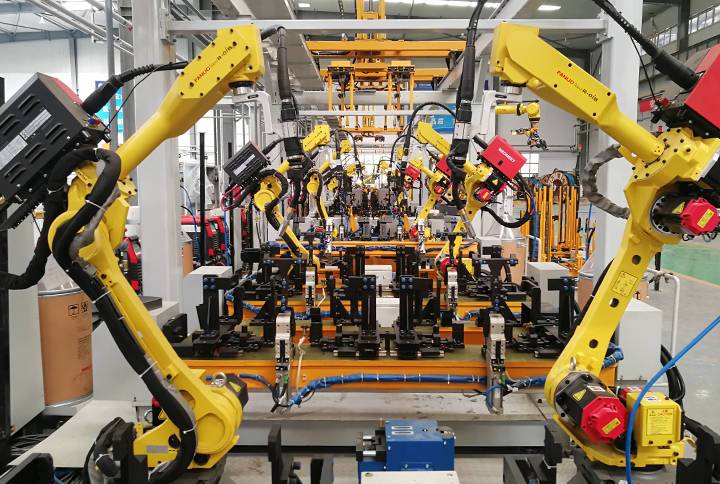
Many manufacturers assume robotic welding automation is simply buying a welding robot, installing it, and pressing “start.” In reality, the robot is only 30–40% of the system.
True robotic welding automation depends on:
Joint design and accessibility
Fixture rigidity and repeatability
Heat input control and weld sequencing
Torch angles, wire feeding stability, and spatter control
Real-time sensing and error compensation
This is where robotic welding integrators come in. A good integrator understands welding metallurgy, motion control, fixture engineering, and production takt time—not just robot programming.
A professional welding robot integrator is responsible for the entire welding ecosystem, not just automation hardware. This includes:
Without this system-level thinking, robotic welding automation often fails—not immediately, but slowly, through unstable weld quality and constant manual rework.
Most welding automation integrators claim they are “experienced” or “turnkey.” That doesn’t tell you much. Instead, ask technical questions:
(1). Can they explain weld defects before they appear?
Experienced robotic welding integrators can predict where porosity, lack of fusion, or burn-through will happen—before the system is built.
(2). Can they integrate sensing and control, not just motion?
A serious automated weld control solution includes seam tracking, arc sensing, laser vision, and adaptive parameter adjustment—not fixed programs.
(3). Have they handled your industry specifically?
Automotive, construction machinery, trailers, containers, pressure vessels—each requires different welding logic.
You won’t always find the best robotic welding integrators ranking first on Google. Reliable integrators usually share these traits:
These companies focus less on selling robots and more on making robotic welding automation work under pressure.
Many factories use the same robot brand but achieve completely different results. The difference lies in the welding robot integrator.
A strong integrator can make a mid-range robot outperform a premium robot installed poorly. They optimize:
That’s why experienced robotic welding integrators are often booked months in advance.
We are not a robot manufacturer—we are a robotic welding automation integrator, and that distinction matters.
Founded in 1994, we have spent decades building welding automation systems that survive real production conditions. Our work spans automotive components, construction machinery, trailers, containers, steel structures, and heavy equipment.
What makes our approach different:
We don’t just deliver equipment—we make sure robotic welding automation reaches stable mass production.
Finding reliable robotic welding integrators is not about price or robot brand. It’s about engineering depth, field experience, and long-term responsibility.
If you plan to implement robotic welding automation, you can contact us to design a solution for you. Rest assured, we will provide the solution free of charge. Of course, many robotic welding automation integrators can provide you with solutions, but with over 20 years of experience and hundreds of integrated workstations and production lines, please trust that we can definitely solve your needs.
 TAG:
TAG: