Stock Code: 831045
Industrial Automation & Intelligence Solutions
SUMMERY: Walk through any modern car factory, and you'll notice something immediately: the humans are outnumbered. Not replaced—outnumbered. The advantages of robots in car manufacturing have evolved far beyond the simple "they work faster" narra...
Walk through any modern car factory, and you’ll notice something immediately: the humans are outnumbered. Not replaced—outnumbered. The advantages of robots in car manufacturing have evolved far beyond the simple “they work faster” narrative that dominated automation discussions twenty years ago.
Today, the conversation is about physics, precision, and the fundamental limits of human capability. Let’s look under the hood at what robots actually bring to the table.
Here’s the uncomfortable truth about human labor: we’re inconsistent. A welder at 8 AM is different from the same welder at 3 PM. Monday’s work varies from Friday’s. This isn’t a flaw—it’s biology. But biology doesn’t build cars that last 200,000 miles.
The primary driver for industrial robots in car manufacturing industry has always been consistency. A robot performs the same motion with the same accuracy at cycle 1 and cycle 10,000. When you’re assembling components that require micron-level precision—like mounting an engine or positioning suspension components—that repeatability isn’t just convenient. It’s essential.
Modern robotic automation in manufacturing achieves positional accuracy within 0.05mm on multi-ton parts. Try asking a human to hold a car door within the width of a human hair for eight hours straight.
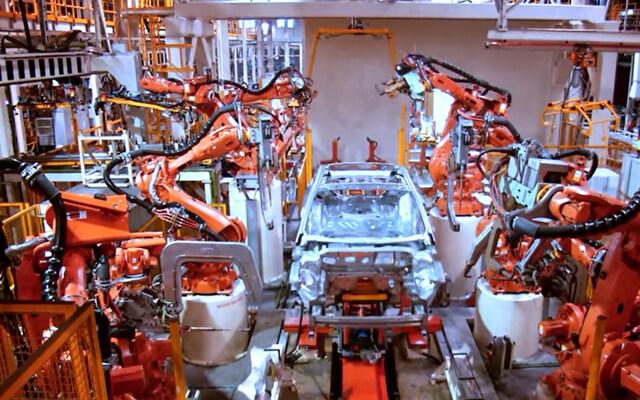
Some tasks in automotive assembly simply exceed human physical capability. Consider spot welding on a unibody chassis. A single car body requires 4,000 to 6,000 spot welds. Each weld requires precise force application—typically 400 to 600 pounds of clamping force—delivered at exactly the right angle.
A human with a welding gun can manage perhaps 100 welds before fatigue compromises force consistency. An industrial robots in car manufacturing industry setup handles thousands without breaking form. This isn’t about replacing labor—it’s about performing tasks that physics makes impractical for human operators.
Paint applications represent one of the most dramatic demonstrations of robotic automation in manufacturing advantages. Automotive paint requires absolute uniformity—variations in film thickness as small as 10 microns create visible defects.
Robotic painters don’t breathe. They don’t tire. They don’t create airborne contaminants through skin cells or clothing fibers. More importantly, they navigate the spray booth environment without exposing humans to isocyanates and other hazardous chemicals.
Modern painting robots combine six-axis articulation with vision systems that map each car body individually, adjusting path and flow rate for variations between vehicles. The result is finish quality that hand spraying simply cannot match.
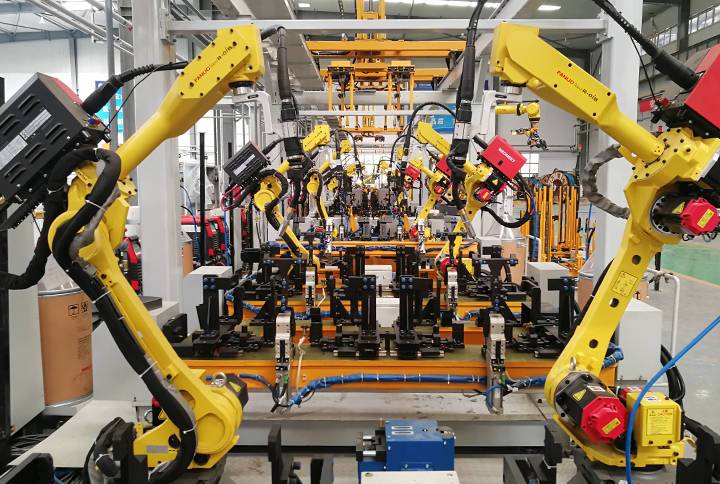
The structural integrity of every modern vehicle depends on robotic welding integration . A car body is essentially a sculpture of stamped steel sheets, welded together into a load-bearing structure. The welds must be perfect—every single one.
Here’s what makes robotic welding integration indispensable: the heat affected zone. When welding thin automotive steels, the window between “good fusion” and “burn-through” is milliseconds. Robots monitor the process in real-time, adjusting current and force based on dynamic resistance feedback. They detect variations in material thickness, coating presence, and fit-up gaps, compensating instantly.
Without this capability, the lightweight, high-strength vehicle architectures that define modern cars simply wouldn’t exist. The 47% improvement in torsional rigidity that automakers advertise? That’s robotic welding integration enabling thinner materials with optimized joint design.
Traditional automation meant hard tooling—dedicated machines that did one thing, forever. Change the product, scrap the machine. The advantages of robots in car manufacturing include fundamental flexibility.
When a car model changes, robots get new software. The same industrial robots in car manufacturing industry that welded door frames for the outgoing model weld battery trays for the next. A study of automotive manufacturers found that robotic workcells reduced changeover time between model generations by approximately 60% compared to hard automation.
This flexibility extends to mixed-model production. Today’s assembly lines build multiple variants sequentially—sedan followed by SUV followed by electric. Robots adapt instantly, downloading the appropriate program as each body approaches.
Perhaps the most overlooked advantage of robotic automation in manufacturing is the data. Every robot generates a continuous stream of process information: cycle times, force profiles, positional data, weld signatures.
This data transforms quality control. Instead of sampling finished vehicles for destructive testing, manufacturers analyze every operation in real-time. When a weld parameter drifts by 2%, the system flags it before the weld fails. When a torque curve deviates from baseline, the controller stops the line.
For robotic welding integration, this means traceability. Every weld on every car has a digital fingerprint. If a field failure occurs years later, manufacturers can trace that specific weld back to the exact robot, the exact program version, the exact electrode condition when it was made.
None of this eliminates human workers. What actually happens in facilities with extensive industrial robots in car manufacturing industry is role evolution. Operators become supervisors, managing fleets of machines. Technicians develop diagnostic skills. Engineers focus on process optimization rather than repetitive tasks.
The modern assembly plant employs more software engineers than welders. The work is different—cleaner, safer, more analytical—but the headcount remains substantial. Robotic automation in manufacturing doesn’t replace people; it replaces the parts of jobs that break bodies and bore minds.
Understanding the advantages of robots in car manufacturing requires more than reading spec sheets. It requires knowing how these systems behave when production targets tighten, when materials vary, when operators rotate shifts.
We’ve been integrating robotic welding integration systems since 1994. Before “Industry 4.0” was a buzzword, we were helping automakers figure out why their welds failed on Tuesday but passed on Wednesday. We learned that the difference between a system that delivers and one that frustrates isn’t the robot—it’s the integration.
We’ve shipped industrial robots in car manufacturing industry solutions globally, from passenger vehicle assembly to commercial truck fabrication. Every installation includes on-site engineering support—not just for startup, but for the ongoing partnership that turns automation investments into competitive advantage.
The advantages of robots in car manufacturing are real. They’re measurable. They’re essential to modern vehicle production. But they don’t happen automatically. They happen when experienced integrators match technology to application, when engineers understand both robotics and metallurgy, when support extends beyond the warranty period.
That’s what thirty years looks like. Let us show you what it can do for your line.
 TAG:
TAG: