Stock Code: 831045
Industrial Automation & Intelligence Solutions
SUMMERY: Every boiler or pressure vessel that leaves a fabrication shop carries the weight of expectation. It will be pressurized, heated, cycled, and sometimes abused—and it must not fail. At the heart of that reliability lies thousands of indiv...
Every boiler or pressure vessel that leaves a fabrication shop carries the weight of expectation. It will be pressurized, heated, cycled, and sometimes abused—and it must not fail. At the heart of that reliability lies thousands of individual strength-welded tube to tubesheet joint connections. When one of those joints lets go, the consequences range from costly downtime to catastrophic equipment loss.
We have spent over fifteen years building systems that help fabricators get these critical joints right. The difference between a joint that holds and one that fails often comes down to how consistently you can produce a true strength weld tube to tubesheet—and that consistency is exactly what automation delivers.
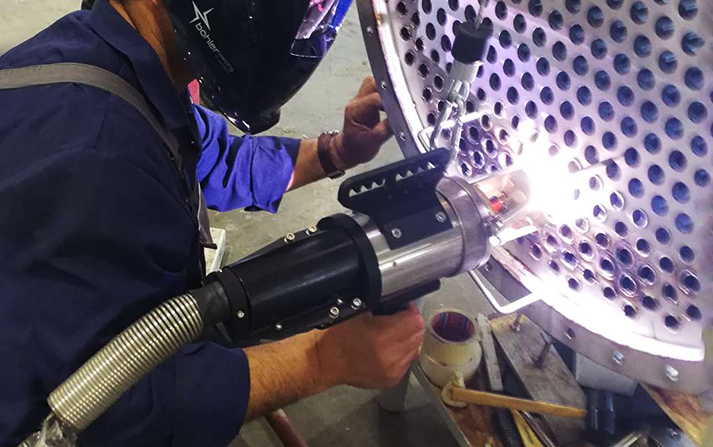
A strength-welded tube to tubesheet joint is fundamentally different from a seal weld. Seal welds merely close the gap at the tube-to-tubesheet interface; they prevent leakage but contribute little to structural integrity. A strength weld, by contrast, is designed to transfer the full axial load from the tube into the tubesheet. It must resist pull-out forces generated by pressure, thermal expansion, and external loads.
Achieving this requires specific geometry. The tube typically protrudes 2–3 mm beyond the tubesheet face, and a fillet weld of calculated throat thickness is laid around the circumference. For flush configurations, deep penetration or multiple passes are necessary to develop equivalent strength. The weld metal itself must be compatible with both tube and tubesheet materials—often requiring filler metals like 309L for stainless-to-carbon steel joints.
Codes such as ASME Section VIII and Section I impose strict rules on how a strength weld tube to tubesheet must be designed and qualified. The weld size must be sufficient to develop the full tensile strength of the tube, and the procedure must be validated through destructive testing of mock-ups. These requirements exist because a failed tube to tube sheet joint in a boiler or pressure vessel is not a minor leak—it is a safety event.
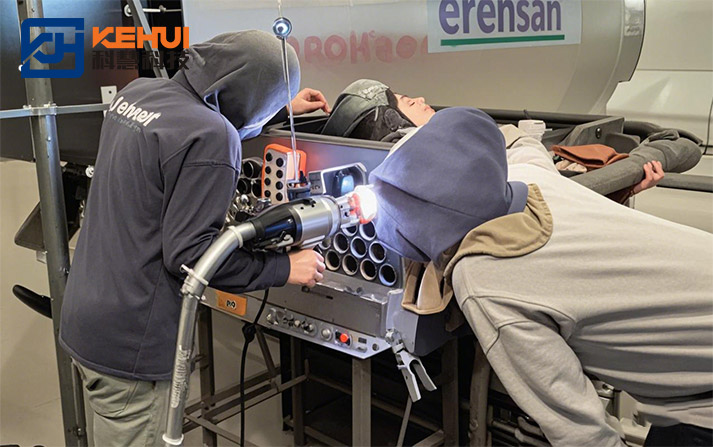
Manual welding of tube-to-tubesheet joints is notoriously difficult. The welder must maintain a steady hand while orbiting around each tube, often in cramped bundles. Arc length varies as the torch moves. Travel speed fluctuates with fatigue. Shielding gas coverage can be compromised by awkward positioning. The result is a statistical spread of weld quality—some joints meet strength requirements, others fall short.
In a strength-welded tube to tubesheet joint, that variability is unacceptable. If one joint in a thousand has incomplete fusion or insufficient throat thickness, it becomes the weak link. Under cyclic loading, that joint will fail first. The failure may propagate, leading to tube rupture, collateral damage, and unscheduled shutdowns.
This is where an automatic tube to tubesheet welding machine changes the game. Automation removes the human factors that cause inconsistency. The machine maintains constant arc length through electronic sensing. Travel speed is governed by precision gearing. Pulse parameters adjust for material and position. Every weld is executed exactly as the qualified procedure dictates.
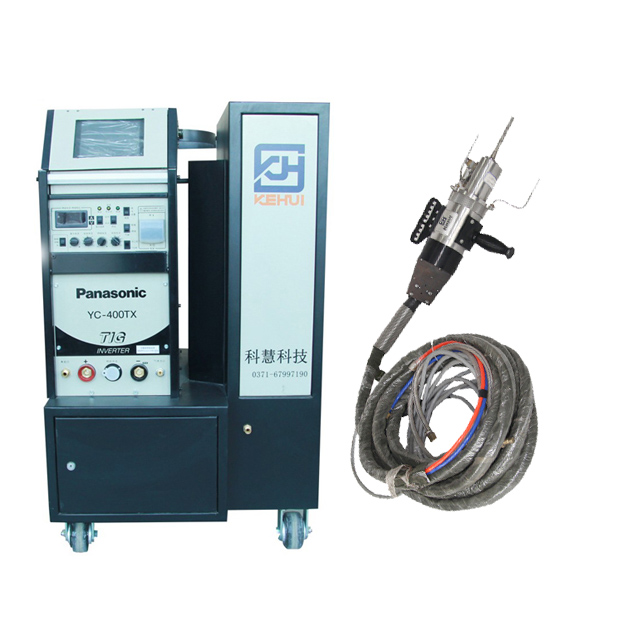
Our approach to building automatic tube to tubesheet welding machine systems starts with the recognition that strength welds demand precision at every level. The welding head must be capable of repeatable positioning, stable rotation, and controlled heat input.
The tube-to-tube-sheet orbital welding heads we manufacture feature expanding mandrels that center the head on the tube ID. This ensures the tungsten is concentric regardless of tube ovality or minor misalignment. If the head is off-center, arc length varies, penetration varies, and the resulting strength-welded tube to tubesheet joint will not have uniform strength around the circumference.
Three-axis tungsten adjustment allows the operator to set the exact stickout and angle required for the joint geometry. For protruding tubes, a torch angle of 5–10 degrees directs the arc into the corner, creating proper fusion at the root. For flush tubes, a steeper angle may be used to achieve deep penetration.
Water cooling is integrated into the head body, enabling continuous operation at the high currents often needed for thick-walled tubes or multiple passes. Air-cooled heads overheat, forcing stops that disrupt production and introduce thermal variation. With water cooling, the head maintains stable temperature, and weld parameters remain consistent across hundreds of joints.
The need for reliable strength weld tube to tubesheet connections spans multiple industries, but the most demanding applications are in power generation and petrochemical processing.
In high-pressure feedwater heaters, tubes operate at pressures exceeding 3000 psi and temperatures above 500°F. The strength-welded tube to tubesheet joint must withstand not only steady-state loads but also the thermal shocks of start-up and shut-down. Research has shown that combining welding with full-depth tube expansion creates redundancy—the weld carries axial loads while expansion ensures intimate contact and blocks crevice corrosion.
In waste heat boilers used in refineries, tubesheets can be enormous—two meters or more in diameter—with thousands of tubes. Manual welding of every tube to tube sheet joint would take weeks and still produce unacceptable reject rates. An automatic tube to tubesheet welding machine equipped with multiple heads allows one operator to monitor several welds simultaneously, inspecting completed joints while the machines continue working.
In nuclear pressure vessels, where every weld must be documented and traceable, automation provides the data logging required for code compliance. Parameters for each strength-welded tube to tubesheet joint are recorded and stored. If a question arises years later, the fabrication history is available.
Developing a qualified procedure for a strength weld tube to tubesheet involves several steps. First, the joint geometry must be defined—tube protrusion, groove details if used, and required throat thickness. Next, the filler metal is selected based on base material compatibility.
Test coupons are welded using the proposed parameters, then sectioned and examined. Macro-etch samples reveal penetration depth, fusion lines, and any defects. For strength welds, the weld throat must meet or exceed the design requirement. Some codes also require shear testing to confirm that the joint actually develops the tube’s full tensile strength.
Once the procedure is qualified, it is programmed into the automatic tube to tubesheet welding machine. The machine stores multiple schedules for different tube sizes, materials, and joint configurations. Operators select the appropriate program, and the system sets current, pulse frequency, travel speed, and wire feed automatically.
Modern fabrication standards increasingly demand proof that every strength-welded tube to tubesheet joint meets requirements. Our automatic tube to tubesheet welding machine systems include comprehensive data logging. For each weld, the system records:
– Weld schedule identification
– Actual current and voltage throughout the cycle
– Travel speed and wire feed rate
– Arc time and date
– Operator identification
This data can be exported for quality records or integrated with plant management systems. If a joint is ever questioned, the complete weld history is available. For nuclear and military work, this level of traceability is mandatory.
We have seen what happens when a strength-welded tube to tubesheet joint fails in service. In one case, a leak in a boiler feedwater heater led to erosion of adjacent tubes, cascading into multiple failures within months. The repair required weeks of downtime, replacement of dozens of tubes, and requalification of all joints.
In another instance, a pressure vessel in a chemical plant developed a crack at a strength-welded joint after only two years of service. Investigation revealed that the weld had insufficient throat thickness—the procedure had been qualified but production welds did not match the qualification. Manual welding variation had allowed a few joints to slip through with inadequate size.
An automatic tube to tubesheet welding machine eliminates that variation. Every joint is made with the same parameters as the qualification coupon. The throat thickness is consistent. The fusion is complete. The strength is predictable.
Fabricators who switch from manual to automated welding for strength-welded tube joints typically cite three reasons:
First, quality improves. Reject rates drop from double digits to under 2%. Rework costs disappear.
Second, production increases. One operator running multiple heads can outproduce a team of manual welders.
Third, documentation becomes automatic. Instead of relying on handwritten logs, you have electronic records that satisfy auditors and customers.
The tube-to-tube-sheet orbital welding heads we build are designed to make this transition seamless. They fit into the same tube patterns, use the same power sources, and require minimal retraining for experienced weld technicians.
A strength-welded tube to tubesheet joint is not just a weld—it is a commitment to safety and reliability. In boilers and pressure vessels, where failure is not an option, that commitment demands the best possible process control. Manual welding, however skilled, cannot match the consistency of an automated system.
If you are fabricating equipment that requires true strength-welded tube joints, consider what automation can do for your shop. Bring a sample tubesheet, and we will run it on our floor. You will see the difference in consistency, in appearance, and in the data. No pressure, no jargon—just decades of helping people build safer, more reliable pressure equipment.
 TAG:
TAG: