Stock Code: 831045
Industrial Automation & Intelligence Solutions
SUMMERY: When a fabrication shop searches for a magnatech orbital welding machine for large-diameter pipe girth welding, the first question should not simply be “Can the machine weld large pipe?” The more useful question is: Which Magnatech weldi...
When a fabrication shop searches for a magnatech orbital welding machine for large-diameter pipe girth welding, the first question should not simply be “Can the machine weld large pipe?” The more useful question is: Which Magnatech welding head, welding process, pipe diameter range, and joint configuration match the actual production job?
For large-diameter pipe, the welding circumference becomes long, wall thickness can increase significantly, and manual welding quality may vary as operators work around different positions of the joint. This is where mechanized or orbital welding becomes useful.
Magnatech’s product range includes different approaches. Its Pipeliner II, for example, is designed for multi-pass GMAW/FCAW pipe-to-pipe and pipe-to-fitting welding and uses interchangeable guide rings for pipe sizes from 168 to 1,524 mm (6–60 in.) and larger. Its D-Head 420, by comparison, is a GTAW system covering approximately 25–356 mm (1–14 in.).
That difference is important when comparing magnatech orbital welding equipment with other solutions.
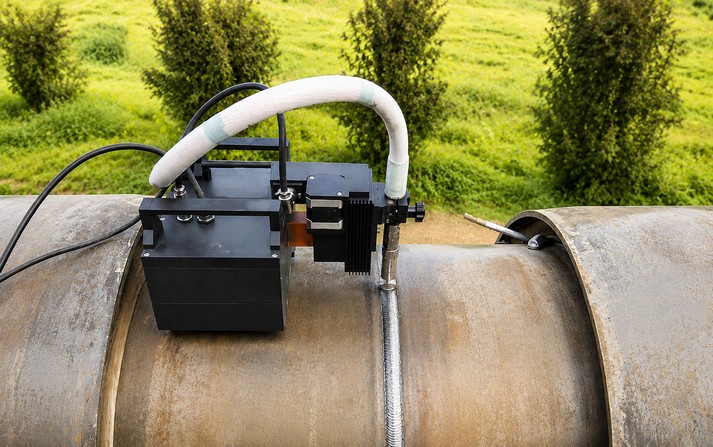
Large diameter pipe welding is not simply a scaled-up version of small tube welding.
As pipe diameter increases, three production problems become more noticeable:
For example, a 24-inch pipe has a circumference of roughly 1.9 meters, while a 48-inch pipe is roughly 3.8 meters around. A small change in travel speed, torch angle, wire feed or oscillation can therefore affect a considerable length of weld.
In a factory environment, this makes pipe girth welding automation attractive because the welding head can maintain a programmed travel path instead of relying entirely on an operator to reproduce the same movement.
A practical system normally needs:
This is why buyers comparing orbital welding machine manufacturers should evaluate the complete welding system rather than only the welding head.
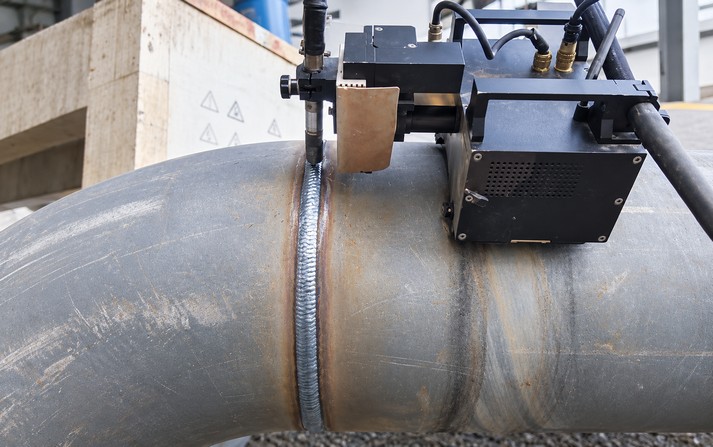
The magnatech orbital welding machine concept covers several types of orbital welding equipment rather than one universal machine.
For large pipe, the Pipeliner II is particularly relevant. According to Magnatech’s published specifications, it is designed for multi-pass GMAW/FCAW pipe-to-pipe and pipe-to-fitting welding, with interchangeable guide rings covering 168–1,524 mm and larger. The system provides torch rotation, filler-wire feeding, motorized arc-gap control and electronic oscillation.
That configuration makes the system fundamentally different from a compact GTAW orbital head used on smaller tubing.
This is one of the easiest mistakes when researching magnatech orbital welding.
The D-Head 420 is a multi-pass orbital GTAW head designed for pipe and tube sizes of approximately 25–356 mm. It supports filler wire, oscillation and arc-gap control and is compatible with Magnatech Pipemaster power sources.
For substantially larger pipe, a GMAW/FCAW system such as the Pipeliner II may be a more relevant equipment category because large joints often involve multiple passes and higher deposition requirements. The correct choice ultimately depends on material, wall thickness, groove design, welding procedure and required production rate.
A factory evaluating orbital welding machine manufacturers should collect several technical details before requesting quotations.
Do not only provide the maximum diameter.
Give the manufacturer your:
A system designed for 6–60-inch pipe may be unnecessary for a workshop whose normal production is 8–16-inch pipe, while a smaller orbital head may not be appropriate for very large pipe.
Ask whether the proposed system uses:
For large diameter pipe welding, process selection can have a major effect on deposition rate and the number of welding passes.
For pipe girth welding, the travel mechanism is critical.
A good system must remain stable around the complete circumference without noticeable changes in travel speed. The guide ring also needs to accommodate the actual pipe diameter and site conditions.
Magnatech’s Pipeliner II, for example, uses interchangeable guide rings to adapt the welding head to different pipe sizes.
Look beyond the phrase “automatic welding.”
Ask whether the system can control or program:
Magnatech’s Pipemaster 516 controller, for example, is designed to operate Magnatech GTAW weld heads and provides control functions including torch rotation, filler-wire feed, electronic arc-gap control and electronic oscillation.
A buyer comparing orbital welding machine manufacturers should avoid comparing brands only by their advertised maximum pipe diameter.
A more useful factory comparison looks like this:
| Comparison point | What to investigate |
|---|---|
| Pipe range | Actual production diameter, not only maximum capacity |
| Welding process | GTAW, GMAW, FCAW or hybrid |
| Wall thickness | Maximum practical thickness for your procedure |
| Welding passes | Root, fill and cap capability |
| Travel system | Guide ring, rail or track |
| Parameter control | Manual, programmable or automatic |
| Torch control | Rotation, oscillation, arc gap |
| Setup time | How quickly the head can move between joints |
| Training | Factory training and on-site commissioning |
| Service | Spare parts, remote support and field service |
| Customization | Ability to adapt the system to existing production |
This comparison is especially useful when a company is researching magnatech orbital welding but is still deciding whether it needs a proprietary imported system, a customized orbital welding line, or a more cost-conscious alternative.
From a production perspective, automation makes the most sense when the same type of joint appears repeatedly.
Imagine a pipe fabrication workshop producing hundreds of similar pipe sections. The operator still needs to inspect fit-up, tack welds, alignment and consumables, but the actual circumferential welding can be controlled much more consistently.
The advantage is not simply “less labor.”
The bigger benefit is repeatability.
For large diameter pipe welding, repeatability can help reduce variations in:
However, an orbital welding machine cannot compensate for poor joint preparation. Excessive root gap, inconsistent bevel geometry or pipe misalignment can still create welding problems.
This is why experienced orbital welding machine manufacturers normally need information about the complete welding procedure before recommending a machine.
No single orbital welding platform is suitable for every large-pipe application.
The magnatech orbital welding machine range is one option for automated pipe welding, but buyers can also compare systems from other orbital welding machine manufacturers based on diameter range, welding process, automation level, local service and total investment.
For example, modern large-pipe orbital systems on the market use track-type or ring-based designs, while some systems combine automated TIG with hot-wire technology for larger pipe and heavy-wall applications.
For a purchasing team, the better question is therefore:
Which orbital welding system can reproduce our qualified welding procedure across the pipe diameters we actually manufacture?
That question is more useful than simply asking which machine has the largest advertised diameter.
Before contacting an orbital welding machine manufacturer, prepare these details:
With this information, suppliers can recommend a welding head and power-source combination instead of quoting a machine based only on pipe diameter.
Yes, certain Magnatech systems are designed specifically for large pipe. The Pipeliner II is specified for 168–1,524 mm (6–60 in.) and larger pipe and is designed for multi-pass GMAW/FCAW pipe-to-pipe and pipe-to-fitting welding.
Magnatech orbital welding mechanizes torch movement around the pipe circumference, allowing travel and other welding parameters to be controlled more consistently. Manual welding still gives the operator direct control but can introduce greater variation over long circumferential joints.
It depends on the diameter and welding procedure. The D-Head 420 is specified for approximately 25–356 mm (1–14 in.), while larger pipe applications may require a different Magnatech head and welding process.
Compare the complete system: pipe diameter, wall thickness, welding process, guide system, parameter control, production rate, training, spare parts and after-sales service. Maximum pipe diameter alone is not enough.
Yes. Orbital systems are specifically used to mechanize circumferential pipe girth welding, particularly where repeated pipe joints and consistent welding parameters are important.
Send the pipe diameter and wall thickness range, material, joint drawing or groove dimensions, welding process, number of passes, expected production volume and whether the equipment will be used in a workshop or on-site. This allows orbital welding machine manufacturers to evaluate the application more accurately.
 TAG:
TAG: We value your message!
Please fill the below, We will customized the solution to your needs.