Stock Code: 831045
Industrial Automation & Intelligence Solutions
SUMMERY: Choosing between a welding track carriage and a magnetic welding carriage is not simply a matter of choosing the more automated machine. The better choice depends on the workpiece material, weld location, surface geometry, pipe diameter,...
Choosing between a welding track carriage and a magnetic welding carriage is not simply a matter of choosing the more automated machine. The better choice depends on the workpiece material, weld location, surface geometry, pipe diameter, joint type, and how often the equipment needs to be repositioned.
In a fabrication shop, for example, a magnetic welding carriage can be convenient when welding directly on large carbon-steel structures. But when the weld follows a large curved surface or a specific circumferential path, a flexible track welding carriage can provide a more controlled travel path.
The distinction becomes particularly important for pipe girth welding, storage tanks, pressure vessels, shipbuilding, and structural steel fabrication. Track-guided systems are designed around a defined travel path, while magnetic carriages can often move directly on a ferromagnetic workpiece. Commercial systems also combine these concepts, using magnetic or vacuum fixing to hold a flexible rail in place.
Before looking at individual applications, the basic difference can be summarized as follows:
| Feature | Welding Track Carriage | Magnetic Welding Carriage |
|---|---|---|
| Travel guidance | Track or rail | Magnetic wheels/drive |
| Direct contact with workpiece | Usually no | Yes |
| Curved surfaces | Excellent with flexible track | Depends on machine design |
| Large pipe girth welding | Very suitable | Suitable on magnetic steel |
| Non-ferromagnetic material | Possible with appropriate track | Generally unsuitable without another fixing method |
| Setup | Track installation required | Usually faster |
| Travel path | More controlled | Depends on surface condition |
| Large tanks | Excellent with flexible track | Good for suitable steel surfaces |
| Portability | Good | Usually very good |
| Typical use | Tanks, vessels, pipes, long seams | Steel structures, tanks, pipes, field welding |
The important point is that welding track carriage and magnetic carriage are not necessarily competing technologies. In some systems, the track itself is magnetically fixed to the workpiece, combining the guidance of a track with the holding force of magnets.
A welding track carriage travels along a dedicated rail or track while carrying the welding torch.
The track establishes the travel path, while the carriage controls movement along that path. Depending on the system, the track may be rigid, flexible, straight, or formed into a ring.
A flexible track welding carriage is particularly useful when the welding surface is curved.
The flexible track can follow the contour of:
This is why a flexible track welding carriage can be useful when a rigid rail would require a dedicated fixture for each diameter.
Commercial flexible-track systems are specifically marketed for curved tanks, pressure vessels, large-diameter pipes and circumferential welding.
The practical advantage is not just automation. It is path control.
Suppose a workshop needs to weld the circumference of a large pipe. If the carriage is guided by a properly installed track, the torch follows a predefined route around the joint instead of relying on the operator to maintain the same path manually.
For repeated pipe girth welding, this can simplify parameter setup and improve repeatability.
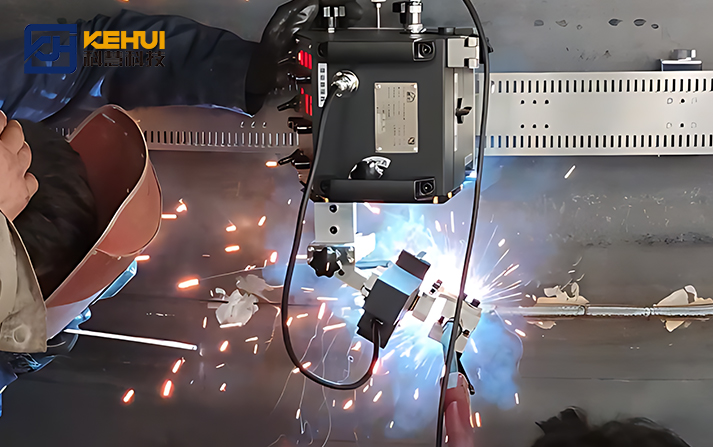
A magnetic welding carriage normally uses permanent magnets or magnetic wheels to adhere to a ferromagnetic workpiece.
The carriage itself becomes the traveling platform for the welding torch.
This approach eliminates the need to install a separate rail in some applications.
A magnetic welding carriage can be particularly practical for:
For example, a magnetic carriage can travel directly on a steel surface while maintaining a programmed travel speed. Some commercial systems are designed to work on horizontal, vertical and curved steel surfaces.
Magnets need a suitable ferromagnetic surface.
That means a magnetic welding carriage is not automatically suitable for stainless steel, aluminum or other non-magnetic materials. Surface coatings, contamination, curvature and the actual magnetic holding force also need to be considered.
This is one reason a flexible track welding carriage may be more versatile for certain projects: the track can provide the travel path without requiring the carriage itself to magnetically adhere to the workpiece.
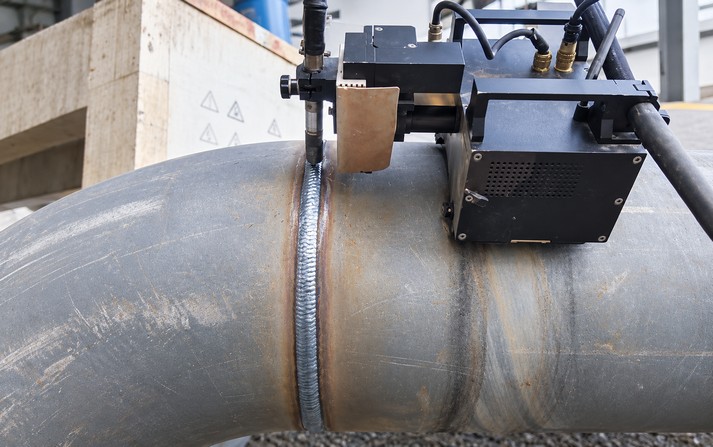
The best way to choose between a welding track carriage and a magnetic welding carriage is to start with the actual job rather than the machine name.
For pipe girth welding, both systems can work.
A welding carriage for large pipe girth welding becomes particularly attractive when the pipe is too large to rotate conveniently or when the welding head needs to travel around a stationary pipe.
A flexible track can be installed around the circumference and the carriage travels around the joint.
A magnetic carriage can perform a similar movement directly on a suitable carbon-steel pipe.
If the pipe is:
then a magnetic welding carriage can reduce setup time.
If the application requires:
then a flexible track welding carriage deserves closer consideration.
Large storage tanks are a different situation.
A tank may contain several types of seams, including:
A welding track carriage can be configured around the required seam, and flexible tracks are particularly useful for curved tank shells.
For large tank fabrication, track length can also be customized to match the workpiece geometry. This approach is already used in industrial carriage systems for tanks and other large fabrications.
A magnetic welding carriage, meanwhile, can be attractive when the tank is made from suitable carbon steel and the machine can maintain stable traction on the surface.
Structural steel fabrication often involves long fillet and butt welds on:
For these jobs, a welding carriage for structural steel welding can reduce the amount of manual torch travel required on long repetitive joints.
A magnetic carriage can be especially convenient when the weld is on a ferromagnetic surface and the operator needs to reposition the machine frequently.
For long, repetitive straight welds, however, a track can give the torch a more defined path.
Commercial welding carriage systems are used for structural fabrication, shipbuilding, bridges and tank construction, including both rigid and flexible track configurations.
A welding carriage for pressure vessel welding needs a little more consideration than a general-purpose carriage.
Pressure vessel fabrication may involve thick plates, curved shells, longitudinal seams and circumferential seams. Weld procedures can also be tightly controlled.
A flexible track welding carriage can be useful for following curved vessel surfaces while maintaining a defined travel path.
A magnetic carriage may also work effectively when the vessel material provides sufficient magnetic adhesion.
However, the machine should be evaluated together with the actual welding procedure—not simply its advertised travel speed.
Before purchasing, confirm:
For pressure-vessel production, repeatability of the complete welding process is more important than simply making the carriage move automatically.
In real production, the choice often comes down to setup time versus path control.
A flexible track welding carriage is therefore not automatically “better” than a magnetic carriage. It solves a different production problem.
This is something buyers sometimes discover only after the equipment arrives.
A magnetic carriage depends on the actual magnetic contact between the machine and the workpiece. Thick paint, rust, scale, gaps, curved surfaces and contamination can affect traction.
A track-based system moves this issue to the track installation itself.
For a welding track carriage, the track needs to be properly positioned and secured. Once installed, however, the carriage follows the track rather than depending entirely on magnetic traction against the workpiece.
For field fabrication, this distinction can matter considerably.
Before requesting a quotation, provide more than “I need an automatic welding carriage.”
A manufacturer will normally need to know:
This information allows the supplier to determine whether a magnetic system, rigid rail or flexible track welding carriage is appropriate.
A welding track carriage is generally preferable when controlled travel and curved-surface adaptability are important. A magnetic welding carriage is often more convenient when fast setup and direct travel on ferromagnetic steel are the priority.
For large tanks and stationary pipes, a flexible track can provide a controlled path around the workpiece. For repetitive steel fabrication and field jobs where the machine needs to move quickly between welds, magnetic travel can reduce setup work.
The right choice ultimately depends on the material, geometry, welding position and production workflow rather than the machine name alone.
A welding track carriage follows a dedicated rail or track, while a magnetic welding carriage normally uses magnetic wheels or magnets to travel directly on a ferromagnetic workpiece.
Yes. A flexible track welding carriage can follow the circumference of large pipes and cylindrical vessels, making it suitable for stationary pipe girth welding where the pipe itself cannot easily be rotated.
Yes, when the pipe material and surface provide sufficient magnetic adhesion. A magnetic welding carriage is commonly considered for large steel pipes and tanks where direct travel on the workpiece is practical.
Both can be used. A welding carriage for pressure vessel welding should be selected according to the vessel material, diameter, thickness, joint geometry and welding procedure. A flexible track is particularly useful when controlled travel along curved shells is required.
Some systems can. A carriage with interchangeable rigid and flexible tracks can cover different geometries, while a magnetic carriage may travel directly across suitable steel surfaces. The specific track and torch configuration should be checked for each welding application.
Depending on the machine, automated carriages can support processes such as MIG/MAG, FCAW, TIG or other welding configurations. Commercial systems are available for both long-seam and circumferential welding applications.
 TAG:
TAG: We value your message!
Please fill the below, We will customized the solution to your needs.