Stock Code: 831045
Industrial Automation & Intelligence Solutions
SUMMERY: In pressure vessel manufacturing, welding efficiency is not simply about how fast a machine can move. The real question is how quickly a welding system can complete a stable, repeatable circumferential seam without excessive operator int...
In pressure vessel manufacturing, welding efficiency is not simply about how fast a machine can move. The real question is how quickly a welding system can complete a stable, repeatable circumferential seam without excessive operator intervention, arc stops, repositioning, or rework.
This is why an automatic welding tractor should be evaluated under actual production conditions rather than only by its advertised travel speed.
For manufacturers working with tanks, pressure vessels, cylinders, and other large cylindrical components, this article explains how we evaluate an automatic welding tractor for pressure vessel applications and which factors have the greatest impact on production efficiency.
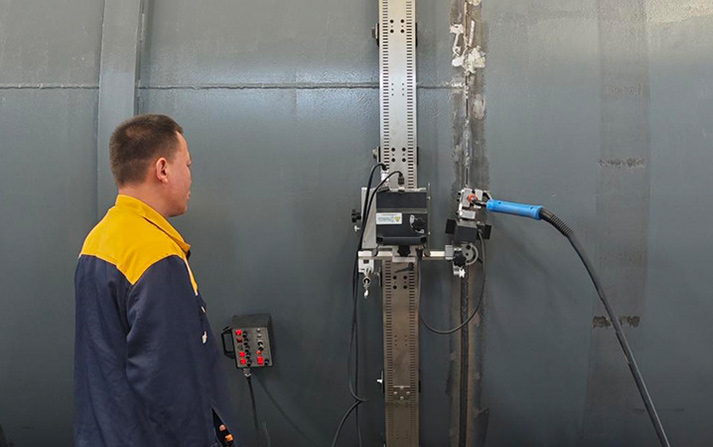
For pressure vessel circumferential seam welding, efficiency should be measured across the complete welding cycle.
A useful production calculation is:
Total welding cycle = positioning + setup + arc-on welding + repositioning + inspection/rework
A faster tractor does not necessarily produce a faster production cycle if the operator needs to frequently correct the torch position or restart the weld.
In a factory test, we normally look at:
For example, if a seam welding tractor travels smoothly at a consistent speed while maintaining the correct torch position, the actual productivity can be higher even if its nominal travel speed is not the highest on the market.
This is particularly important for large pressure vessels, where one circumferential seam can represent a substantial welding length.
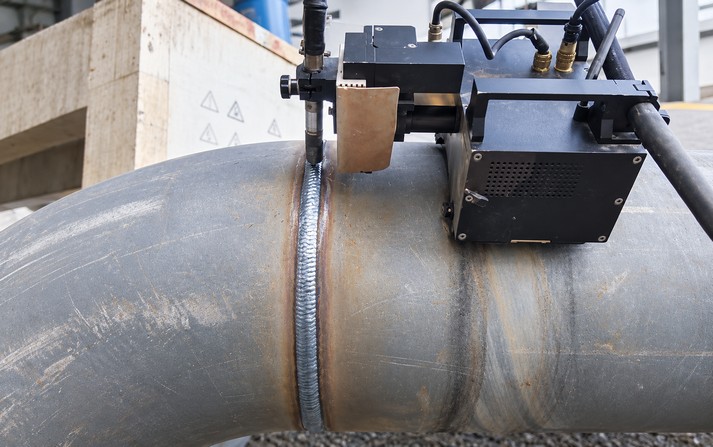
A realistic test should use a workpiece similar to the customer’s production parts.
Instead of testing only a short sample plate, we prefer to evaluate the automatic welding tractor on an actual cylindrical workpiece or representative pressure vessel shell.
Before welding, we record:
Fit-up matters because an automated system cannot completely compensate for a poorly prepared joint.
For pressure vessel circumferential seam welding, inconsistent alignment can cause torch-to-joint deviation, uneven penetration, or changes in bead geometry.
The next test focuses on how the track welding tractor follows the welding path.
Depending on the application, the tractor may run on a guide rail, flexible track, or another guiding structure.
The key question is not simply whether the track welding tractor can move around the vessel. It is whether it can maintain stable movement while the welding torch remains correctly aligned with the joint.
This becomes more important on large-diameter vessels where even a small tracking deviation can affect the weld.
The welding clock starts when the arc is established and stops after the seam is completed.
This gives us the actual welding time.
However, factory productivity depends on more than arc-on time. We also record:
This gives a much more realistic picture of pressure vessel welding automation.
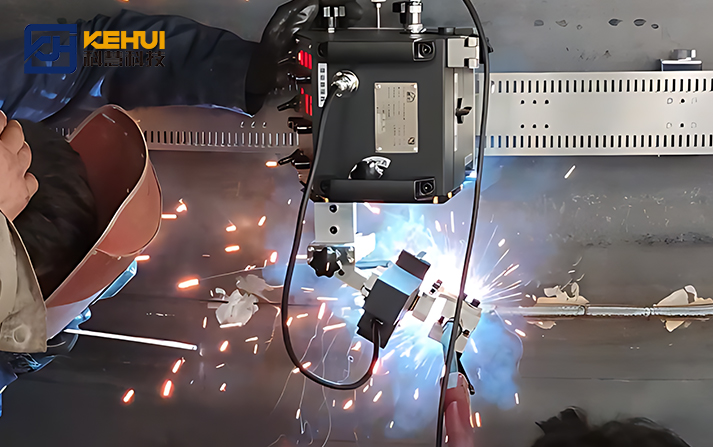
The biggest advantage of an automatic welding tractor is not necessarily higher travel speed.
It is the reduction of repetitive manual work.
During manual circumferential welding, the operator continuously controls torch movement and welding speed.
With a seam welding tractor, the operator can focus more on monitoring the arc, weld pool, parameters, and overall process.
For repetitive pressure vessel production, this can make the welding process considerably more consistent.
A track welding tractor can maintain a relatively consistent travel speed along the predefined path.
This helps reduce variations caused by:
For circumferential seam welding, maintaining stable travel speed is especially important because the welding position changes continuously around the vessel.
A good automatic welding system should allow the operator to complete a long seam with minimal interruption.
In practical production, reducing unnecessary stops can be just as valuable as increasing travel speed.
This is one reason we recommend evaluating the entire welding cycle instead of comparing tractors only by their maximum speed.
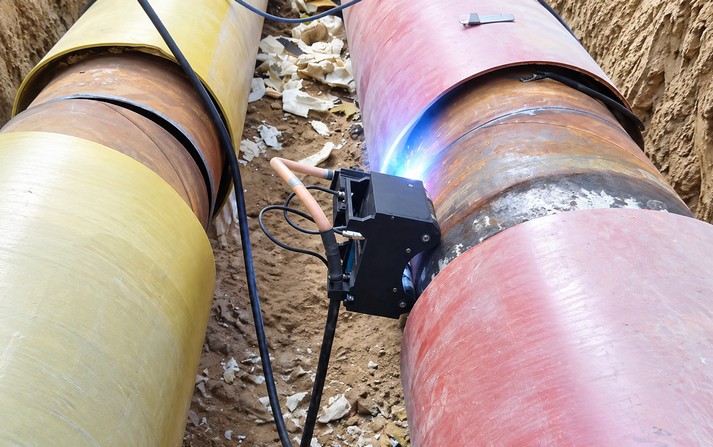
Suppose a pressure vessel manufacturer needs to weld multiple circular joints on similar cylindrical vessels.
With manual welding, the operator needs to control torch movement throughout the seam. As production continues, differences in travel speed and torch manipulation may become more noticeable.
With an automatic welding tractor, the welding path and travel movement can be controlled more consistently.
The production advantage becomes clearer when the same type of seam is repeated dozens or hundreds of times.
In this situation, the value of an automatic welding tractor for pressure vessel production comes from repeatability as much as from speed.
A useful test should measure more than welding speed.
| Test Item | What It Tells the Manufacturer |
|---|---|
| Travel speed | Basic welding productivity |
| Arc-on time | Actual welding efficiency |
| Total cycle time | Real production efficiency |
| Tracking stability | Seam-following capability |
| Start/stop performance | Risk of defects at weld ends |
| Operator intervention | Level of automation |
| Weld appearance | Process consistency |
| Rework rate | Hidden production cost |
This type of test provides a better basis for selecting a seam welding tractor than comparing machine specifications alone.
Not every track welding tractor is suitable for every pressure vessel.
Before selecting equipment, manufacturers should consider the vessel diameter, welding position, joint configuration, welding process, available installation space, and required production volume.
If a factory produces many vessels with similar dimensions, a dedicated automatic welding tractor for pressure vessel production can provide strong repeatability.
If vessel dimensions change frequently, flexibility becomes more important.
The guiding method, tractor mounting, torch adjustment, and control system should allow practical adjustment without creating excessive setup time.
For large vessels and tanks, the stability of the guide system becomes particularly important. A track welding tractor should remain securely guided throughout the welding path rather than relying on constant manual correction.
When evaluating an automatic welding tractor, we recommend calculating productivity using the complete production cycle.
A simple formula is:
Productivity = completed weld length ÷ total production time
This includes setup and operator intervention.
A machine that welds slightly faster but requires frequent adjustment may not outperform a slower system with better stability.
For this reason, a proper efficiency test of pressure vessel circumferential seam welding should combine speed, stability, weld quality, and operator workload.
The efficiency of an automatic welding tractor for pressure vessel production should be judged by what happens during the complete welding cycle—not just by maximum travel speed.
For manufacturers performing pressure vessel circumferential seam welding, the most meaningful indicators are stable tracking, consistent travel speed, reduced operator intervention, fewer interruptions, repeatable weld quality, and shorter total cycle time.
When these factors work together, a seam welding tractor becomes more than a mechanized welding tool. It becomes a practical part of the factory’s production process.
For companies evaluating an automatic welding tractor for pressure vessel fabrication, testing the equipment on a representative workpiece is often the most reliable way to determine whether the proposed welding solution can meet actual production requirements.
An automatic welding tractor is used to mechanize welding torch travel along a predefined welding path. In pressure vessel manufacturing, it can be used for circumferential seams, longitudinal seams, and other repetitive welding operations depending on the machine configuration.
Yes. A seam welding tractor can be configured for pressure vessel circumferential seam welding when its guiding system, torch positioning, welding process, and operating range match the workpiece requirements.
A track welding tractor generally refers to a tractor that travels along a guide track or rail. An automatic welding tractor describes the broader function of mechanizing the welding movement. In many applications, the same machine can be described using both terms.
The most useful test compares travel speed, arc-on time, total cycle time, tracking stability, operator intervention, weld quality, and rework. Testing on a representative pressure vessel or cylindrical workpiece gives more meaningful results than testing the tractor’s travel speed alone.
Manufacturers should evaluate vessel diameter, wall thickness, joint preparation, welding process, guiding method, welding position, production volume, setup time, and required weld quality. These factors determine whether an automatic welding tractor for pressure vessel applications is suitable for the actual production environment.
 TAG:
TAG: We value your message!
Please fill the below, We will customized the solution to your needs.