The Three Decisions That Determine Everything
Decision One: Track-Mounted or Magnetic?
This is the first fork in the road, and it’s the one most buyers get wrong because they focus on the machine instead of the pipe.
Track-mounted systems follow a rigid, semi-flexible, or ring-shaped rail. The carriage travels on the track, and the torch position is controlled by the rail geometry. Setup requires mounting and aligning the track on the pipe OD. For repeated joints on the same diameter, the setup amortizes across the run. For one-off welds or mixed diameters, the setup time becomes dead time.
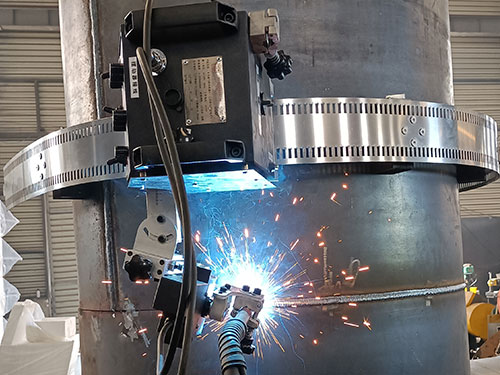
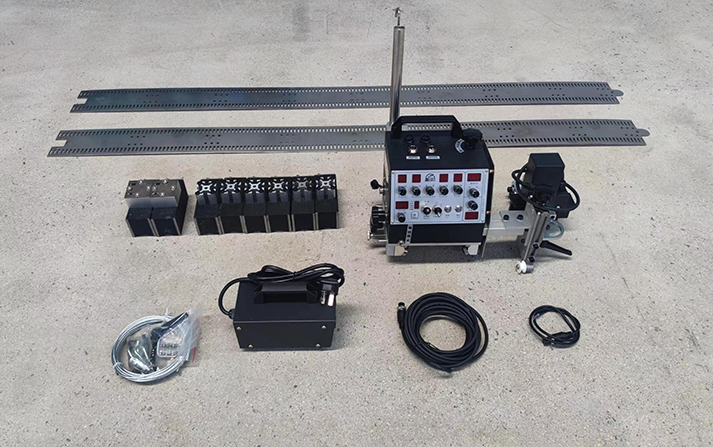
Magnetic welding tractors attach directly to the ferromagnetic pipe surface with permanent magnets. No track installation. The WQ-III magnetic pipe welding tractor is a representative example: 16 kg, four magnetic wheels, travel speed adjustable from 0 to 700 mm/min, with a swing function for oscillation. Setup takes minutes instead of tens of minutes.
The trade-off is real. Magnetic adhesion depends on the pipe surface being clean, bare, and reasonably round. Mill scale, rust, and heavy spatter all reduce grip. On a pipeline spread where the pipe OD has been wire-brushed, that’s manageable. In a shop where pipe has been sitting outside for months, it’s a daily fight.
Track systems don’t care about surface conditions. The rail provides the travel path regardless of what’s underneath. That’s why stainless, aluminum, and coated pipe require track-mounted systems—magnets simply don’t work.
Decision Two: What’s Your Dominant Wall Thickness?
Diameter gets all the attention, but wall thickness determines the process, the heat input, and the equipment configuration.
If your work is mostly schedule 40 and heavier (wall thickness above 0.2 inch), you need an automatic girth welding machine with robust cooling, high duty cycle, and strong arc starting. An open-head design is usually sufficient because oxidation is less critical on thick wall.
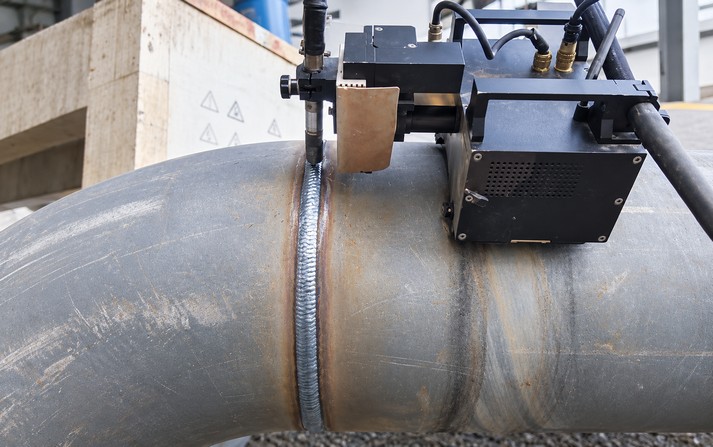
If you weld schedule 10 or thinner—especially stainless—you need a closed-head system that seals the weld zone with shielding gas. Oxidation will ruin a circumferential butt weld on thin-wall stainless regardless of operator skill. A closed head creates a controlled atmosphere around the arc, and that’s the only reliable way to prevent discoloration and porosity.
If you do both, you have three options: buy two separate systems (expensive), buy a closed-head only and accept slower setup on thick wall (inefficient), or buy a modular system that lets you swap between open and closed heads on one power source. The modular route is the cost-effective middle ground, and it’s increasingly common among established automatic girth welding machine manufacturers.
Decision Three: How Many Joints Per Day?
Production volume determines whether an automatic girth welding machine pays for itself at all.
Mechanized systems cost roughly $150,000 to $500,000 per spread, but lower labor per joint and less rework recover the difference after approximately 15 to 30 kilometers of mainline pipe. In terms of joint count, that break-even lands around 1,500 to 3,000 girth welds. Below that volume, semi-automatic welding remains the lower-cost option.
But the break-even calculation changes when you factor in repair rates. Semi-automatic welding on large-diameter pipe typically runs 3 to 10 percent repair rate. Automatic welding drops that below 2 percent. On a 36-inch line, a single repair can stop the spread for a full shift. A process that lowers the reject rate by a few percentage points pays for itself in schedule time alone.
For shop-based spool fabrication, the math is different again. A fabricator running year-round work with consistent joint configurations doesn’t need to hit the 15-30 km threshold. The equipment runs continuously, and the productivity gain compounds across every shift.
What the Productivity Numbers Actually Look Like
A mechanized spread completes 60 to 120 girth welds per day while holding first-pass acceptance rates above 95 percent. Manual stick welding crews on comparable pipe sizes complete 25 to 40 joints per day with 80 to 90 percent first-pass acceptance.
The China-Russia East Route pipeline project illustrates the gap at scale: 1,422 mm diameter pipe, 7 hours per girth weld manually, 1 hour with robotic welding—a 7x productivity improvement on flat terrain and 4x in mountainous sections.
But productivity numbers don’t translate directly between projects. Terrain, access, weather, and pipe grade all affect the outcome. What transfers is the relationship: machine-controlled travel speed and arc parameters reduce the variance that manual welding introduces. That variance reduction is where the quality and cost gains come from.
A Practical Selection Framework
The honest answer for many shops is that you need both types. A track-mounted system for the long, critical runs and a magnetic welding tractor for the fillets, field work, and changeover-heavy days. That’s not a sales pitch—it’s what serious fabrication shops eventually figure out after trying to force one machine to do everything.
What to Ask Before You Sign
Ask for a demo on your actual pipe. Not the showroom pipe. Yours, with your wall thickness, your surface condition, and your access constraints. A magnetic welding tractor that runs perfectly on clean 12-inch pipe may struggle on 48-inch pipe with mill scale.
Ask about wall-thickness programming. An automatic girth welding machine that only programs by diameter will burn through thin-wall stainless. You need a system that stores procedures by diameter and wall thickness.
Ask for a specific reference project. Not a logo list. A project name, a contact, and a repair rate number. The credible manufacturers will have them.
Ask about the total cost of ownership. Acquisition price is roughly half the five-year cost. Fuel, maintenance, operator training, and downtime make up the rest. A $54,000 system with $21,000 in fuel and $15,000 in labor premium over five years has a total cost of ownership around $95,500. Budget for the whole picture, not just the sticker.
FAQ
What is the difference between an automatic girth welding machine and a magnetic welding tractor?
An automatic girth welding machine is the broader category covering any system that automates the circumferential weld around a pipe joint. A magnetic welding tractor is one type within that category—it uses permanent magnets to attach directly to the pipe surface without a guide rail. Track-mounted systems are the other main type, using a physical rail for travel guidance.
Can I use a magnetic welding tractor on stainless steel pipe?
No. Magnetic adhesion requires ferromagnetic material. Stainless steel, aluminum, and duplex piping require a track-mounted system with mechanical or vacuum mounting. For these materials, the automatic girth welding machine must have a track or rail system regardless of other capabilities.
How many joints per day can an automatic girth welding machine complete?
A mechanized spread typically completes 60 to 120 girth welds per day on mainline construction, compared to 25 to 40 for manual welding. Shop-based production with consistent joint configurations can achieve similar or higher rates depending on pipe size and wall thickness.
What pipe diameter range can a large diameter pipe girth welding machine handle?
Track-mounted systems with ring rails cover 8 inches up to roughly 10 feet in diameter as standard, with custom rails extending beyond that. Magnetic welding tractors generally work on pipe from DN140 (approximately 6 inches) and above, with wall thickness of 5 mm or greater. The practical limit for magnetic systems depends on pipe ovality and surface condition.
Is an automatic girth welding machine worth it for a small shop?
It depends on joint volume and repeatability. Below roughly 1,500 total girth welds, semi-automatic welding usually remains more economical. For shops running 10 to 20 joints per day with consistent configurations, the productivity and quality gains often justify the investment within 12 to 18 months.