What the Machine Can Fix — and What It Can’t
A fabrication shop in Alberta ran a trial with a track-mounted welding tractor on 24-inch pipe with 19 mm wall. First day, the repair rate was 1.2%. The shop manager was pleased — manual welding on the same joint typically ran 4–6%. Second day, they swapped in a batch of pipe from a different mill. The repair rate jumped to 7%.
Nothing changed on the machine. The travel speed was identical, the oscillation settings untouched, the wire lot the same. What changed was the pipe. The second batch had slightly different end preparation, and the fit-up crew, working under schedule pressure, closed the root gap tighter than the procedure specified. The automatic welding tractor welded exactly what it was set to weld. The joint quality tanked anyway.
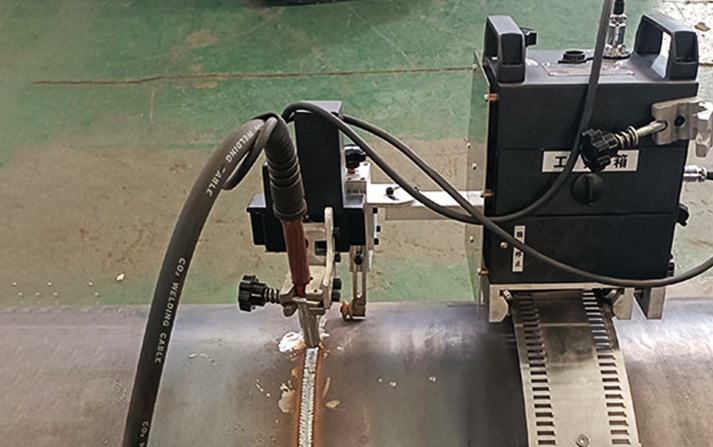
This is the lesson that separates shops that get real value from a pipe girth weld quality improvement initiative from those that just buy equipment and hope: an automatic welding tractor improves pipe girth weld quality by removing the variables it controls — travel speed, torch angle, oscillation consistency, heat input. It does nothing for the variables it doesn’t control. Understanding where that line sits is the difference between a repair rate under 2% and a repair rate that makes you regret the purchase.
Where an Automatic Welding Tractor Actually Improves Pipe Girth Weld Quality
Travel Speed Consistency
Manual welding on a circumferential seam is a continuous negotiation between the welder’s arm, the pipe rotation, and the clock position. A welder moving from the 12 o’clock position to the 3 o’clock position naturally speeds up or slows down as the work angle shifts. On a heavy-wall joint, that variation shows up directly in penetration depth and bead width.
Research on GMA welding confirms the relationship: increasing travel speed decreases both penetration and bead width, and if speed climbs too high, undercut appears along the bead edges and lack-of-fusion zones develop. The inverse is equally true — too slow, and you risk excessive reinforcement, burn-through on thin wall, or heat input that exceeds the procedure qualification.
An automatic welding tractor locks the travel speed. The carriage moves at the same rate at every clock position. On a 36-inch pipe with 25 mm wall, the difference between the 12 o’clock and 6 o’clock positions disappears — at least from the travel speed side of the equation.
The Gullco mechanized pipeline girth welding solution puts this plainly: a powered carriage maintains steady, optimal travel speed without the start-stops of manual technique, and the result is fewer defects and lower per-joint cost.
Torch Angle and Contact-Tip-to-Work Distance
Torch angle is the second variable an automatic welding tractor eliminates. In manual welding, push angle and drag angle change subtly as the welder repositions around the pipe. Research from EWI on track-mounted welding tractors for pipeline girth welding found that most welding bugs only oscillate and move the torch up and down — the welder must manually set the push/drag angle before welding and between passes. Adding an automated axis for torch travel angle provided more mechanized welding with less operator intervention and better adaptive control, especially in 5G fixed-pipe positions where the bug rotates around all orientations.
Contact-tip-to-work distance matters just as much. In GMA welding, changing the gun-to-work distance doesn’t alter arc length — the equipment maintains that automatically — but it does change stick-out, which changes melting rate or welding current, which changes bead size and penetration. A track-mounted automatic welding tractor holds that distance constant through the full circumference. A magnetic welding tractor with a rigid torch mount does the same, provided the pipe OD is reasonably consistent.
Oscillation and Multi-Pass Sequence Control
On thick-wall pipe girth welding, the fill passes are where most quality problems originate. The root pass may be sound, but sidewall fusion in the fill depends on how the torch oscillates — width, speed, dwell time at the sidewalls.
An automatic welding tractor with programmable oscillation runs the same pattern on pass 4 as on pass 2 and pass 6. The heat input is predictable. The overlap between passes is consistent. The consequence is that lack-of-fusion, the defect most commonly associated with fully automatic welding at the 6 o’clock position, becomes a known quantity rather than a random event.
Research published in 2024 on fully automatic welded joints at the 6 o’clock direction found that under reference parameters, weld morphology tends toward convex reinforcement and larger penetration depth at that position. The excessive reinforcement of the pass to be welded is one of the sufficient conditions for lack-of-side-fusion at 6 o’clock, because the arc heat is consumed melting the raised weld metal rather than reaching the groove sidewalls.
This is where circumferential weld automation shows its real value: not in preventing the 6 o’clock problem entirely, but in making it repeatable. If every joint has the same reinforcement profile at 6 o’clock, you can adjust the procedure once and the fix holds. Manual welding produces a different reinforcement profile every time, and the fix never sticks.
Pipe Ovality Compensation
Pipes are never perfectly round. Track-mounted automatic welding tractors with arc voltage control compensate for ovality by maintaining a constant contact-tip-to-work distance through the full circumference, which in turn helps maintain the required heat input and weld bead penetration profile as welding progresses around the fixed pipe.
This is a quality mechanism that manual welding simply cannot replicate at the same consistency level. A welder can adjust torch height by eye, but the adjustment lags the ovality. The tractor’s voltage control responds in real time.
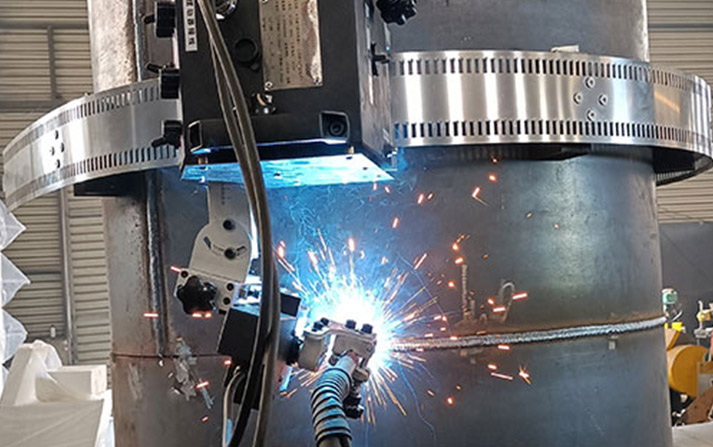
Where an Automatic Welding Tractor Cannot Help
Fit-Up and Hi-Lo Misalignment
No machine compensates for a bad joint. Hi-lo misalignment — the difference between the respective inside edges of the pipes at any point on the circumference — has specified limits for industrial piping and pipelines that typically range from about 1.5 to 3 mm. API 1104 limits misalignment between abutting pipe ends to 1.6 mm internally and externally for common pipe schedules.
An automatic welding tractor welds the joint it’s given. If hi-lo exceeds the limit, the weld may pass visual and radiographic inspection and still be a structural weak point. High weld misalignment is a documented contributor to girth weld quality issues and failures in large-diameter linepipe. The machine’s consistency makes the defect repeatable, not absent.
Groove Gap Variation
Root gap consistency is a fit-up problem, not a welding problem. Root opening should have uniform spacing throughout the circumference of the joint. Adjustments to root gap greater than 1/8 inch on weld assemblies are generally not allowed unless the root-bead segment is replaced.
A magnetic welding tractor running directly on the pipe OD follows the pipe surface. If the root gap opens up at one clock position because the fit-up crew didn’t check it, the tractor doesn’t know. The arc behaves differently in a wider gap — more burn-through risk on the root, different fill volume requirements — and the operator, watching from a distance, may not catch it until the pass is complete.
Track-mounted systems with arc sensing can detect gap variation to some extent, but the fundamental limitation remains: the machine controls the torch, not the joint.
Material and Surface Conditions
Magnetic welding tractors require ferromagnetic pipe. Stainless, aluminum, and duplex are off the table. Even on carbon steel, surface condition matters: mill scale, rust, and heavy spatter reduce magnetic adhesion. A pipe that has been sitting outside for months may need wire brushing before the magnetic wheels will hold reliably. The machine doesn’t care about weld quality — it cares about staying attached.
Track-mounted systems are less sensitive to surface condition but require the pipe OD to be accessible and reasonably round for guide ring or rail mounting. On coated pipe, the coating may need to be removed at the joint area, which is a preparation step independent of the welding method.
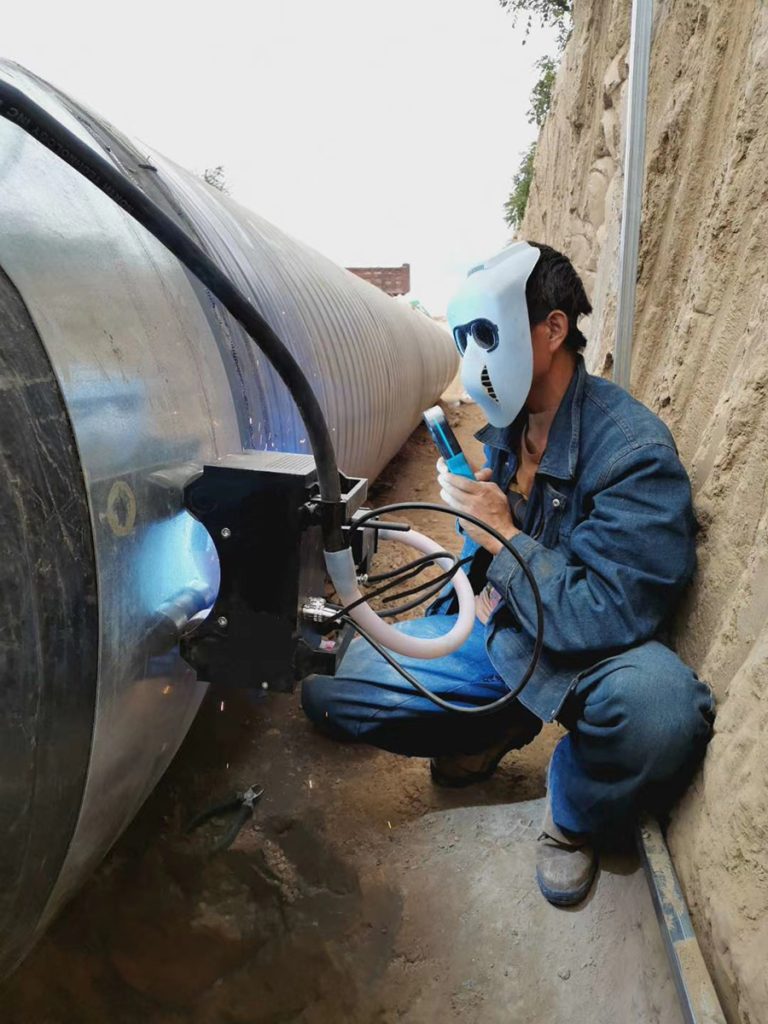
The Practical Quality Checklist Before You Blame the Machine
When pipe girth weld quality drops, the instinct is to adjust welding parameters. That’s often the wrong first move.
Check fit-up first. Measure hi-lo and root gap at four points around the circumference. If either exceeds procedure limits, fix the joint before the automatic welding tractor touches it. A machine welding a bad joint produces a repeatable bad weld.
Check the pipe. Mill-to-mill variation in end preparation, wall thickness, and ovality changes the welding conditions even when everything else stays constant. If you switch pipe suppliers mid-project, re-qualify the procedure.
Check the track or magnetic adhesion. On track-mounted systems, a loose rail changes torch position. On magnetic systems, a weak grip changes everything. Clean the magnetic wheels and check adhesion before every joint.
Then check parameters. Travel speed, oscillation width and dwell, wire feed speed, voltage. These are the variables the automatic welding tractor controls. If the joint and the machine are both correct, the parameters are the only remaining suspects.
Matching the Tractor Type to the Quality Goal
| Quality Challenge | Track-Mounted Automatic Welding Tractor | Magnetic Welding Tractor |
|---|---|---|
| Travel speed consistency | Excellent | Good, surface dependent |
| Torch angle stability | Excellent, programmable axis | Good, rigid mount required |
| Ovality compensation | Arc voltage control available | Limited, follows pipe surface |
| Hi-lo tolerance | Welds what it’s given | Welds what it’s given |
| Groove gap variation | Arc sensing can detect | Operator must monitor |
| Stainless / non-ferrous | Yes | No |
| Setup time per joint | 15–30 min | 2–5 min |
The honest assessment: a track-mounted automatic welding tractor for pipe offers more quality control mechanisms — automated torch angle, arc voltage compensation, programmable oscillation — but requires more setup and only pays off on repeated joints. A magnetic welding tractor for pipe girth welding deploys faster and handles field conditions better but gives up some of the precision mechanisms that make track systems superior on critical, repeated joints.
For shops running both scenarios, the answer isn’t choosing one. It’s matching the tool to the joint. Use the track-mounted system for the production runs where pipe girth weld quality must be repeatable joint after joint. Use the magnetic welding tractor for the field work, the repairs, and the changeover-heavy days where setup time determines whether the job is profitable.
FAQ
Can an automatic welding tractor fix poor pipe fit-up?
No. Fit-up — hi-lo misalignment and root gap uniformity — is a joint preparation issue, not a welding issue. API 1104 limits misalignment to 1.6 mm for common pipe schedules. If the fit-up exceeds specification, the automatic welding tractor will produce a consistent weld on a bad joint, but the weld quality will still fail inspection.
What causes lack of fusion at the 6 o’clock position in pipe girth welding?
Research on fully automatic welded joints shows that excessive reinforcement of the pass to be welded at the 6 o’clock direction consumes arc heat that would otherwise reach the groove sidewalls, leading to lack of side fusion. The molten pool flow resistance also increases at that position due to larger groove curvature radius and lower relative temperature. Programmable oscillation with adjusted dwell time at the sidewalls is the primary countermeasure.
How does travel speed affect pipe girth weld quality?
Increasing travel speed decreases both penetration and bead width. If speed becomes too high, undercut occurs along bead edges and lack-of-fusion zones develop. An automatic welding tractor maintains a consistent travel speed around the full circumference, eliminating the speed variation that manual welding introduces as the welder moves from flat to vertical to overhead positions.
Is a magnetic welding tractor suitable for improving pipe girth weld quality on stainless steel?
No. Magnetic adhesion requires ferromagnetic material. Stainless steel, aluminum, and duplex pipe require a track-mounted automatic welding tractor with mechanical or vacuum mounting. For these materials, the quality improvement mechanisms — travel speed control, torch angle stability, oscillation consistency — are available only on track-mounted systems.
What inspection methods apply to pipe girth weld quality?
API 1104 recognizes visual examination, radiographic testing (RT), magnetic particle (MT), liquid penetrant (PT), ultrasonic testing (UT), and automated ultrasonic testing (AUT). Visual is required on every weld. RT remains the default acceptance medium on most onshore projects. AUT — usually phased array combined with TOFD — is dominant on modern offshore and high-volume onshore projects.