Stock Code: 831045
Industrial Automation & Intelligence Solutions
SUMMERY: Not every automatic pipe welding machine is designed for every pipe size. In real manufacturing, the right solution depends on pipe diameter, joint design, and the production environment. Small precision tubing often requires a closed-he...
Not every automatic pipe welding machine is designed for every pipe size. In real manufacturing, the right solution depends on pipe diameter, joint design, and the production environment. Small precision tubing often requires a closed-head system, medium-sized pipelines benefit from an open-head design, while large diameter pipe welding usually calls for welding carriages that travel around the workpiece. Choosing equipment based on the actual application is the key to improving productivity and weld consistency.
Walk into any fabrication shop and you’ll quickly notice one thing: the same welding machine is rarely used on every project.
A 12 mm instrument tube, a 2-inch process pipe, and a large storage tank all present different challenges. Selecting the correct automatic pipe welding machine helps achieve stable pipe to pipe joint quality while reducing setup time and operator fatigue.
Instead of asking “Which machine is the best?”, experienced engineers usually ask, “Which machine is the best for this pipe size?”
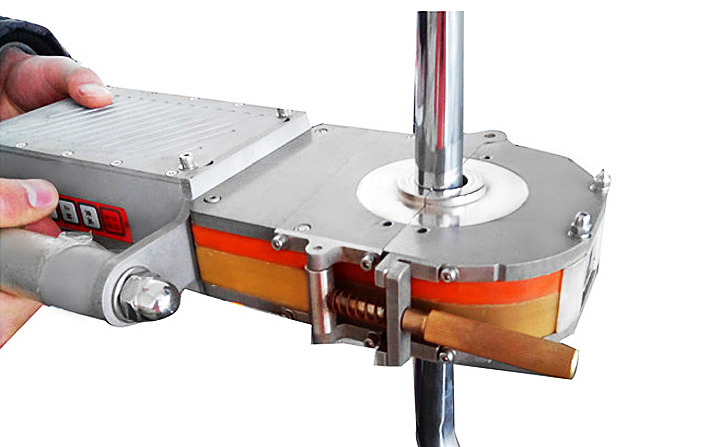
For sanitary piping, semiconductor tubing, pharmaceutical lines, and food-grade stainless steel systems, small pipe welding demands excellent arc stability and shielding gas protection.
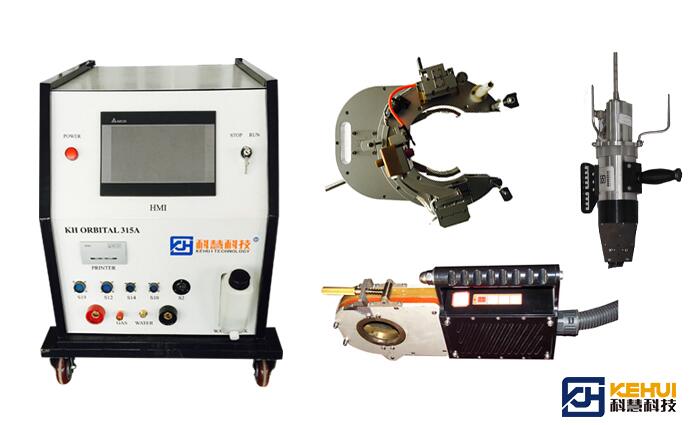
A closed-head automatic pipe welding machine is ideal for these applications because the welding head completely encloses the joint, helping produce clean and repeatable pipe to pipe joint welds.
Typical applications include:
It is also well suited for tig welding 1-inch stainless pipe and tig welding 2-inch stainless pipe, where consistent weld appearance is often required.
As pipe size increases, accessibility becomes a bigger concern.
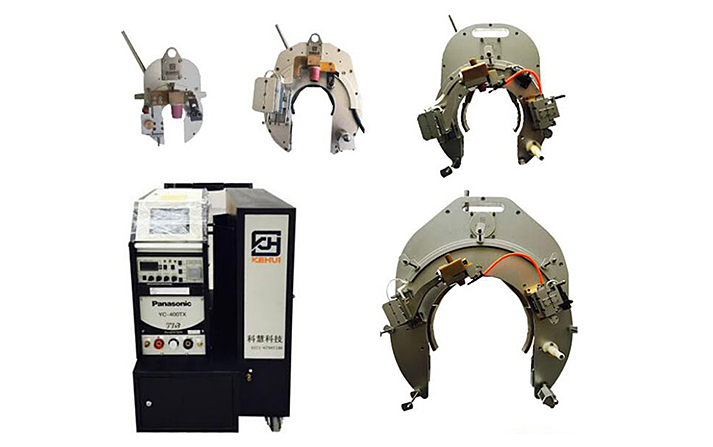
An open-head automatic pipe welding machine allows operators to weld a wider range of pipe diameters while maintaining excellent visibility during setup.
This solution is commonly used for:
It is suitable for tig welding 3-inch stainless pipe and many other medium-diameter applications where reliable pipe to pipe joint quality is essential.
Not every workpiece can be placed on a positioner.
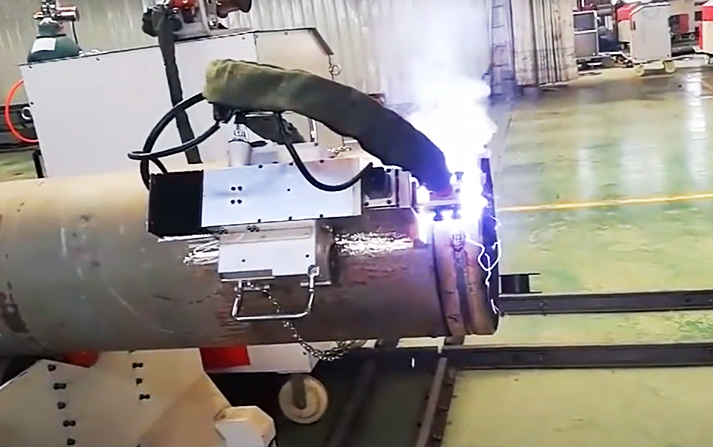
Storage tanks, large cylinders, and oversized process vessels often remain stationary during fabrication. In these situations, large diameter pipe welding is usually performed by moving the welding equipment instead of rotating the workpiece.
A magnetic welding carriage provides an efficient solution for large diameter pipe welding, automatically traveling around the weld seam while maintaining consistent travel speed.
This approach is widely used for heavy industrial fabrication where manual welding would be slow and difficult.
For even larger structures, a welding track carriage offers greater flexibility.
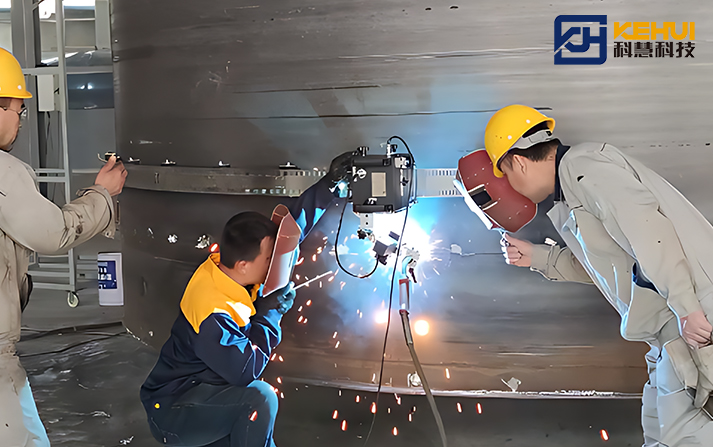
Unlike standard systems, the track length can be customized according to the customer’s production requirements, making it suitable for oversized tanks, pressure vessels, wind towers, and other large fabricated components.
For manufacturers handling frequent large diameter pipe welding projects, customized soft tracks help improve both efficiency and welding consistency.
| Pipe Size / Application | Recommended Solution | Typical Projects |
|---|---|---|
| 3–180 mm | Closed-head automatic pipe welding machine | Instrument tubing, pharmaceutical piping, food-grade systems, small pipe welding |
| 16–300 mm | Open-head automatic pipe welding machine | Process piping, oil & gas, chemical plants, pipe to pipe joint welding |
| Large Diameter Pipes | Magnetic Welding Carriage | Tanks, pressure vessels, large diameter pipe welding |
| Extra-Large Tanks | Welding Track Carriage | Storage tanks, heavy fabrication, customized long-track welding |
The right equipment depends not only on diameter but also on accessibility, production volume, and welding position.
For example, projects involving 6 inch pipe welding may use different solutions depending on whether the pipe can rotate or must remain fixed during fabrication.
Choosing an automatic pipe welding machine is about matching equipment to real production conditions rather than selecting a single universal model.
From precision small pipe welding to demanding large diameter pipe welding, different welding heads and carriage systems solve different manufacturing challenges. By selecting the right solution for each pipe to pipe joint, manufacturers can improve productivity, reduce rework, and achieve more consistent welding quality across a wide range of industrial applications.
Answer: Different machines cover different ranges. Closed-head systems are commonly used for small-diameter pipes, open-head systems for medium diameters, while welding carriages are suitable for large tanks and oversized pipe welding applications.
Answer: No. Different pipe diameters and working conditions require different welding solutions to achieve the best efficiency and weld quality.
Answer: A closed-head system is recommended for high-precision small pipe welding, especially stainless steel tubing used in pharmaceutical, semiconductor, food, and instrumentation industries.
Answer: Open-head systems are better suited for medium-sized industrial pipelines where greater flexibility and easier access are required.
Answer: For large diameter pipe welding and stationary tanks, magnetic welding carriages or welding track carriages are often the most efficient solutions because they move around the workpiece instead of requiring the workpiece to rotate.
Answer: Yes. Many welding track carriage systems can be supplied with customized soft track lengths to match different tank diameters, vessel sizes, and production requirements.
 TAG:
TAG: We value your message!
Please fill the below, We will customized the solution to your needs.