Stock Code: 831045
Industrial Automation & Intelligence Solutions
SUMMERY: What the Magnet Actually Holds — and What It Doesn't A magnetic welding tractor is not a smaller track carriage without a rail. The distinction matters because the two fail in different ways, and the failure modes on a large steel surfa...
A magnetic welding tractor is not a smaller track carriage without a rail. The distinction matters because the two fail in different ways, and the failure modes on a large steel surface are not always obvious during a trial weld. A magnetic orbital welding machine shares the same adhesion principle but wraps the torch around the joint rather than carrying it along a straight path — the two are often confused in procurement discussions.
The magnet holds the machine to the workpiece. Everything else—travel path, torch angle, arc stability—follows from that single physical relationship. When the relationship is reliable, the magnetic welding tractor delivers exactly what it promises: fast deployment, consistent travel, and repeatability across joints that a manual welder cannot match on a 2.8-meter circumferential weld. When the relationship degrades—because the surface is curved, contaminated, or not ferromagnetic—the machine does not simply weld poorly. It behaves unpredictably, and the operator often discovers the problem after the pass is complete.
Here is where a magnetic welding machine for large pipe earns its place on large-diameter pipe and tank work, and where it should stay in the toolbox.
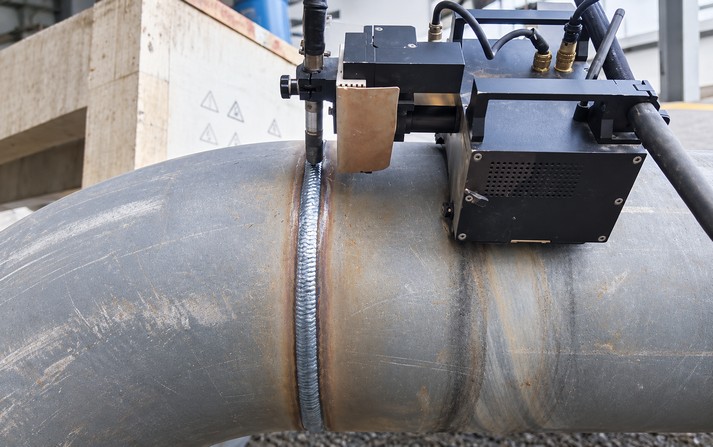
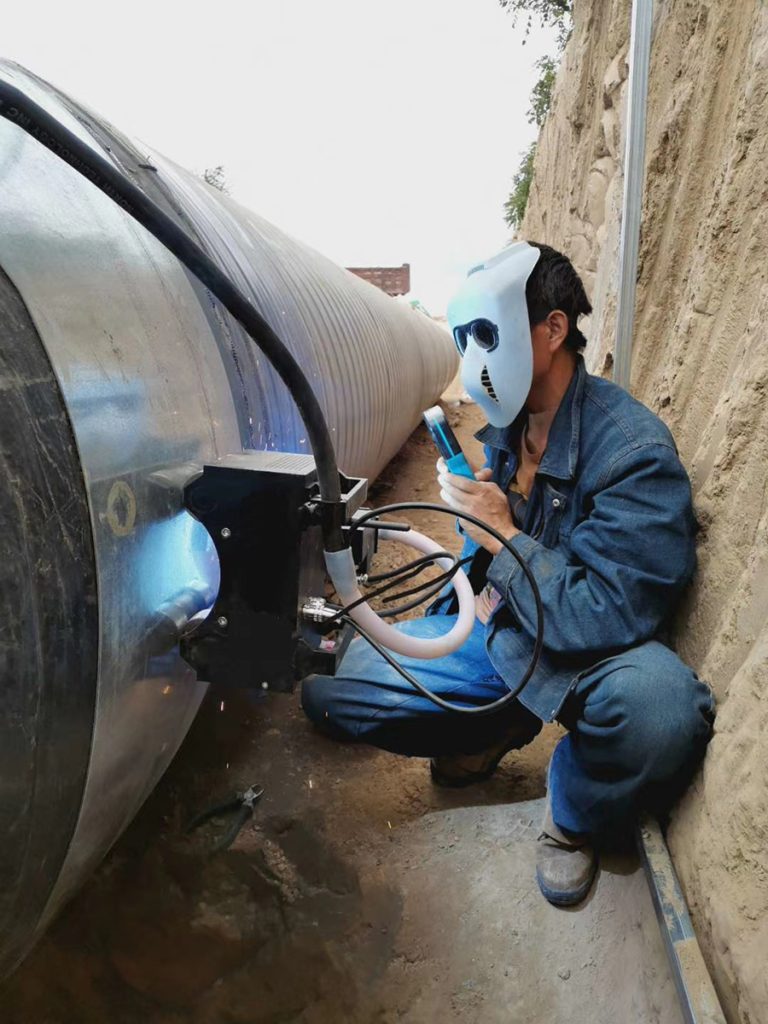
The strongest application for a magnetic welding tractor is on large steel surfaces where the machine can attach directly and travel without obstruction. Large storage tank shells, pipe spools with consistent OD, and vessel courses with good access fall into this category. The PROMOTECH guidance on rail-free tractors is direct: they perform best on magnetic, flat, and even surfaces such as structural steel plates or beams. Tank and vessel fabrication are standard applications for Gullco’s magnetic MOGGY line, alongside structural fabrication and shipbuilding.
The specific advantage on large pipe and tank work is deployment speed. A magnetic welding tractor requires no track installation. On a tank shell where the next seam is ten meters away, that matters more than the sub-millimeter repeatability of a rail system. The ABOKE SAW tractor, for example, uses magnetic adsorption positioning that completes in roughly 30 seconds, compared with fixture-based setups that take far longer.
A magnetic welding tractor can work on vertical and inclined ferromagnetic surfaces where a track carriage would need mechanical anchoring. The Gullco Magnetic MOGGY is specified for continuous travel in the horizontal and vertical position. Some magnetic orbital welding machine designs include an anti-drop safety lock that engages if power is interrupted, which is relevant when the machine is working on a vertical pipe section.
This does not mean the magnetic welding machine for large pipe is suitable for every vertical seam. It means the magnetic adhesion is sufficient to hold the machine’s weight and the reactive force of the arc against gravity. The operator still needs to verify holding force on the specific pipe surface before committing to a pass.
A magnetic welding tractor shines in field conditions where the next joint may be a different diameter or orientation. No ring track to swap, no alignment procedure to repeat. The machine goes where the work is. For repair work, tie-ins, and short production runs across varying pipe sizes, this flexibility is the reason to choose magnetic over track — and the reason a magnetic welding machine for large pipe often replaces a track carriage on mixed-diameter spreads.
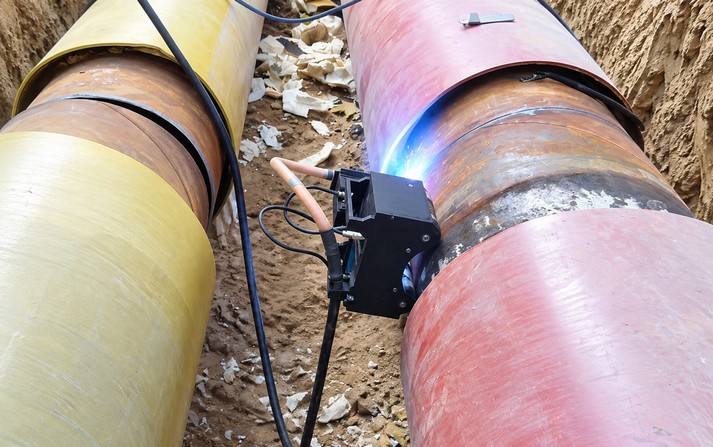
This is the point that causes more misapplication than any other. A magnetic welding tractor and a flexible track carriage with magnetic fixing units are not the same machine, even though both use magnets.
A magnetic welding tractor travels directly on the workpiece surface. The drive wheels or friction system contact the steel, and the magnet holds the chassis against the surface. The path is determined by the tractor’s guidance system and the operator’s steering. A magnetic orbital welding machine works differently again: the torch rotates around the joint on a ring, and the magnet holds the ring to the pipe face rather than driving the chassis along the surface.
A flexible track system uses magnets to fix a track to the workpiece. The carriage then travels on the track, not on the steel surface. The track provides the physical path. PROMOTECH states the practical consequence without ambiguity: when working on curved workpieces such as pipes or tanks, rail-free tractors need to be used with tracks, because the track provides better grip and stability and prevents the tractor from slipping.
The difference shows up in three places:
Path stability on curvature. A magnetic welding tractor running directly on a tank shell follows the surface, but friction drive can wander if the curvature changes or the surface has irregularities. A flexible track mounted on the same shell creates a fixed path that the carriage follows regardless of local surface variation. The track carriage is not relying on friction between wheels and steel to maintain direction.
Surface condition tolerance. A magnetic welding tractor needs clean, bare steel for traction and adhesion. A track system can be mounted with magnetic units at discrete points, and the track itself carries the carriage. Surface irregularities between mounting points matter less because the carriage is not in direct frictional contact with the workpiece.
What “magnetic” is doing in the system. On a magnetic welding tractor, magnetism provides both holding force and traction. On a flexible track with magnetic fixing, magnetism only holds the track in place. The carriage’s travel is mechanically guided by the track. These are different engineering problems, and they have different failure modes.
If the job requires following a curved tank shell or a pipe with meaningful ovality, the flexible track approach with magnetic fixing is generally the more stable configuration. If the job requires fast repositioning across flat or gently curved surfaces, the direct-travel magnetic welding tractor is faster to deploy. Choosing one when the other is appropriate is the most common source of disappointment with either system.
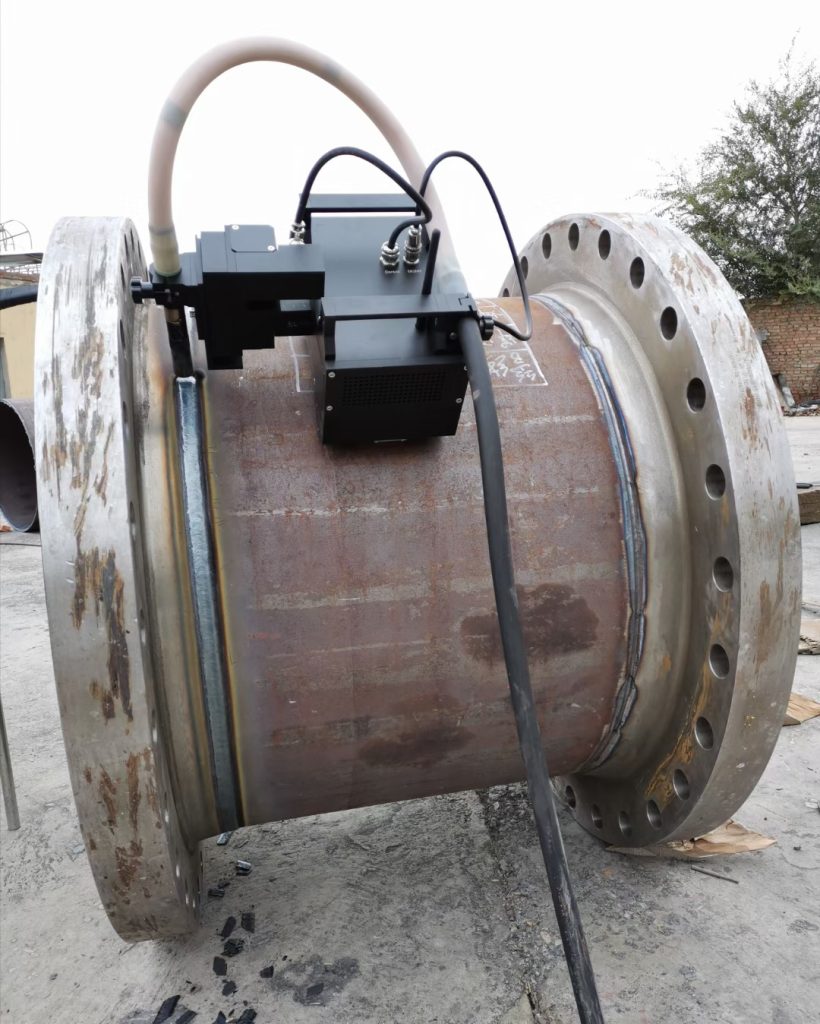
A magnetic welding tractor requires a ferromagnetic workpiece. Carbon steel and most low-alloy steels work. Stainless steel, aluminum, and duplex materials do not. A magnetic orbital welding machine faces the same constraint — the magnet that holds the ring to the pipe face is just as dependent on ferromagnetic material as the tractor’s chassis magnet. The limitation is not about weld quality or procedure—it is about whether the machine can attach at all.
Some product descriptions for magnetic orbital welding machines list stainless steel as an applicable material, but in practice those systems either use a different mounting method or are referring to magnetic stainless grades with limited ferromagnetic response. For standard austenitic stainless, the magnetic welding tractor is not the tool. A track carriage with mechanical or vacuum mounting is the practical alternative.
On a flat plate or a large-radius tank shell, the magnetic welding tractor‘s contact patch is essentially planar. On smaller-diameter pipe, the curvature means the tractor’s wheelbase spans a chord rather than a flat surface. The magnetic air gap at the leading and trailing wheels increases, and holding force drops. Research on non-contact permanent magnetic adhesion robots confirms the relationship: adhesion force decreases rapidly as the air gap increases, and if the gap becomes too large, the robot cannot maintain effective attachment.
This does not mean magnetic welding tractors cannot work on pipe. It means the pipe diameter relative to the tractor’s wheelbase matters. A compact tractor on a large-diameter pipe maintains a small air gap. A large tractor on a small-diameter pipe does not. The practical minimum diameter depends on the specific machine’s geometry, not on a generic spec sheet number.
The more subtle limitation is not whether the magnetic welding tractor stays attached, but whether it stays on the circumferential weld line. Surface irregularities, weld seams from previous passes, and plate joints can cause a rail-free tractor to bounce or deviate from the intended welding path. The magnet holds, but the friction drive loses its reference.
This is why automatic seam tracking becomes important on large pipe welding. Automatic seam tracking with tactile sensors and arc length control allows the tractor to compensate for torch position drift without the operator manually correcting mid-pass. Lorch’s Trac RL series includes integrated arc length control and automatic seam tracking specifically for this reason: to maintain weld quality even under sheet distortion and workpiece tolerances. The ABOKE magnetic SAW tractor specifies seam tracking accuracy of ±0.3 mm with laser-assisted positioning, which is the level of correction needed when the magnetic welding machine for large pipe is following a curved surface.
A magnetic welding tractor without automatic seam tracking on a large curved surface is a machine that welds the path it travels, not necessarily the path the joint takes. On flat plate, that distinction rarely matters. On a 36-inch circumferential weld with ovality, it does.
Magnetic adhesion is not a substitute for fall protection. A magnetic welding tractor working on a vertical tank shell or an elevated pipe section can lose adhesion if the surface condition changes—a patch of heavy mill scale, a sudden discontinuity at a weld seam, or a coating defect. The machine is heavy enough to cause injury and damage if it drops.
The practical safeguard is a tether or safety line independent of the magnetic holding force. Some magnetic orbital welding machine systems include fail-safe features such as an anti-drop lock, but the operator should not rely on the magnet as the only retention method on elevated work. The same principle applies to the cables and hosepack: they must be routed so they cannot pull the magnetic welding tractor off the surface if the operator moves or the cable snags.
Welding heat changes the surface. On thin-wall or high-heat-input applications, localized expansion can alter the contact geometry under the magnetic welding tractor. More importantly, residual magnetism in the pipe—from transport, handling, or previous magnetic operations—can cause arc blow. The problem is well documented in pipeline construction: arc deflection caused by magnetism is a known issue, and on large pipe sizes degaussing may not saturate the material sufficiently to solve it.
A magnetic welding tractor adds its own magnetic field to the workpiece. Whether that field interferes with the welding arc depends on the tractor’s magnetic circuit design and the pipe’s existing magnetic state. This is not a reason to avoid magnetic welding tractors, but it is a reason to test arc stability on the actual circumferential weld before committing to a production run.
| Check | What to Verify | Why It Matters |
|---|---|---|
| Material | Ferromagnetic? | Magnetic adhesion is impossible otherwise |
| Curvature | Pipe diameter vs. tractor wheelbase | Air gap reduces holding force on small OD |
| Surface | Mill scale, coating, rust, spatter | Reduces both adhesion and friction drive traction |
| Path reference | Is there a visible joint line or edge? | Without a reference, the tractor can wander |
| Automatic seam tracking | Is it available? | Compensates for curvature-induced drift |
| Safety | Tether or fall protection on elevated work | Magnet is not a guaranteed retention method |
| Arc stability | Residual magnetism in the pipe | Can cause arc blow, especially on large pipe |
The magnetic welding tractor is the right tool for a specific set of conditions: ferromagnetic material, accessible surface, manageable curvature, and a job where deployment speed outweighs the path precision of a track system. When those conditions hold, a magnetic welding machine for large pipe is one of the most efficient tools on a large pipe or tank job. When they do not, the same machine becomes a source of inconsistent welds and operator frustration—not because it is defective, but because it was the wrong choice for the joint.
For jobs where the curvature or surface condition pushes against the magnetic welding tractor‘s limits, a flexible track welding carriage with magnetic fixing provides the guided path that direct-travel adhesion cannot. For jobs where the material is non-ferromagnetic, neither magnetic option applies, and a mechanically mounted magnetic orbital welding machine is not the answer either — a track carriage with mechanical mounting is the only route to circumferential weld automation. Knowing which condition you are in before the machine arrives on site is the difference between a productive tool and an expensive lesson.
No, not in the standard configuration. A magnetic welding tractor requires a ferromagnetic workpiece. Austenitic stainless steel is not ferromagnetic, so the machine cannot attach. A magnetic orbital welding machine faces the same limitation. For stainless pipe, a track-mounted carriage with mechanical or vacuum fixing is the appropriate solution.
A magnetic welding tractor travels directly on the workpiece surface using magnetic adhesion for both holding force and traction. A flexible track carriage with magnetic fixing uses magnets only to hold the track in place; the carriage then travels on the track, which provides a mechanically guided path. The track system is generally more stable on curved or irregular circumferential weld surfaces.
Surface irregularities, previous weld seams, and pipe curvature can cause the friction drive to bounce or lose its reference. Without automatic seam tracking, the magnetic welding tractor follows its own travel path rather than the joint. Automatic seam tracking with tactile or laser sensors and arc length control compensates for this drift.
Magnetic adhesion can hold a magnetic welding tractor on vertical ferromagnetic surfaces, but it should not be the only retention method on elevated work. A tether or safety line independent of the magnet is the practical safeguard against adhesion loss from surface condition changes.
Yes. Residual magnetism can cause arc blow, and the magnetic welding tractor‘s own magnetic field adds to the workpiece’s existing magnetic state. On large pipe, degaussing may not fully solve the problem. Arc stability should be tested on the actual circumferential weld before production welding with any magnetic orbital welding machine or tractor.
 TAG:
We value your message!
Please fill the below, We will customized the solution to your needs.