Why Pipeline Field Welding Is Different
The gap between welding in a shop and welding in the field is enormous. Pipeline field welding faces challenges that simply don’t exist on a shop floor.
The pipe doesn’t rotate. In a shop, you can put the pipe on a positioner and rotate it while the welder stays still. In the field, the pipe is in the ground. The automatic welding machine for pipeline has to travel around the pipe.
The environment fights you. Wind blows shielding gas away. Rain and humidity affect the weld. Extreme temperatures change how the metal behaves. One pipeline system is rated to operate from −30°C to +60°C—that’s a 90‑degree temperature swing your automatic welding machine for pipeline has to handle.
Fit‑up is never perfect. Shop pipes are cut precisely on a saw. Field pipes are beveled on site, often with portable equipment. The gap varies. The alignment shifts. Pipeline field welding equipment has to tolerate real‑world imperfections.
Access is a nightmare. Welders often work in trenches, overhead, or inside the pipe itself. For big‑bore pipelines (30 inches and larger), manual welders sometimes have to crawl inside the pipe to weld the root pass.
The welder shortage is real. Studies suggest the industry needs hundreds of thousands of new welders. You can’t staff every pipeline project with 20‑year veterans. Pipeline welding automation lets you get consistent results with less experienced operators.
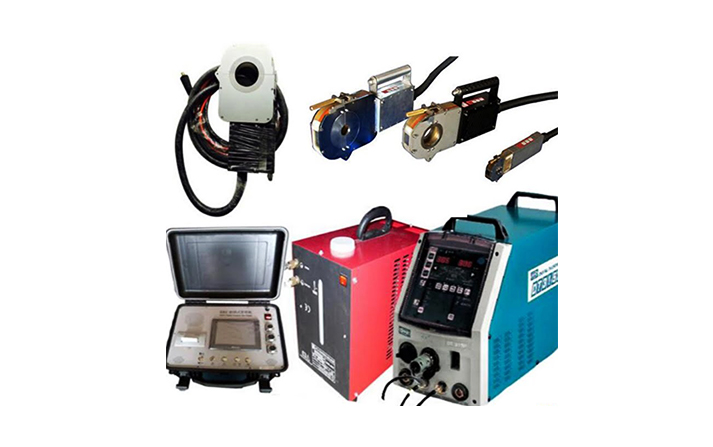
Manual Welding vs. Automatic Pipeline Welding: What Actually Changes
The difference between manual and automatic pipe welding solutions isn’t just speed. It’s consistency, quality, and reliability.
Manual welding depends on the operator’s skill, fatigue level, and attention. Even experienced welders make mistakes. The arc length varies. The travel speed drifts. The torch angle changes. The result? Inconsistent penetration, porosity, inclusions, undercut—defects that require expensive rework.
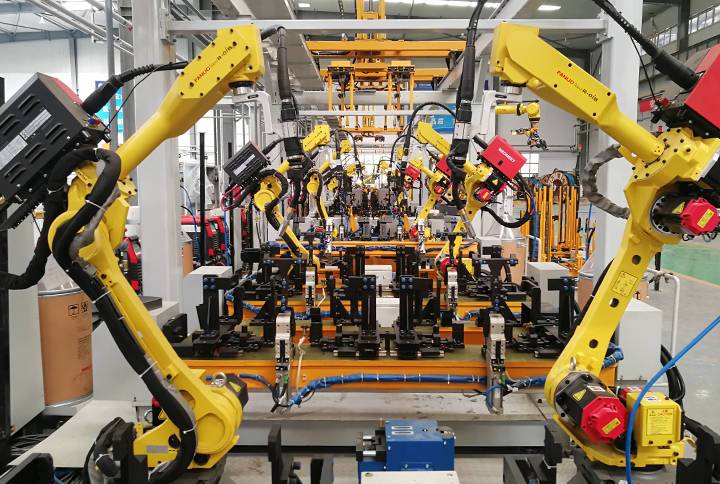
Pipeline welding automation locks in the parameters. The automatic girth welding system controls arc length, travel speed, heat input, and wire feed with precision that no human can match. The weld is the same on joint #1 and joint #500. And because there’s no “fatigue factor,” the automatic welding machine for pipeline produces consistent quality through an entire shift.
One study found that an automated pipeline welding system based on arc weld tracking achieved tracking accuracy of 0.35 mm, producing aesthetically pleasing weld formations. That’s the level of precision you get with automatic pipe welding solutions.
Another study comparing orbital welding to manual welding found a total time saving of 66% with orbital welding. That’s not just faster welding—that’s faster project completion, lower labor costs, and fewer delays.
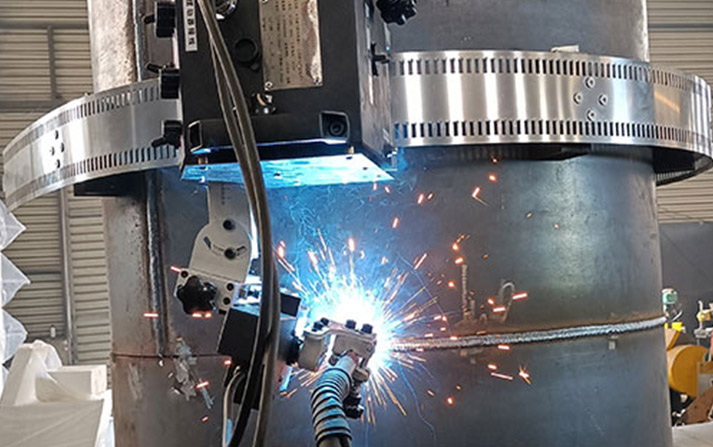
Field Welding Challenges and How Automatic Welding Machines Solve Them
Challenge 1: Wind and Environmental Conditions
The problem: Wind blows away shielding gas. In CO₂ or MIG welding, wind speeds above 5 mph can compromise the weld. In TIG welding, even a light breeze can disrupt gas coverage.
The automatic welding machine for pipeline solution: Many automatic pipe welding solutions use closed‑head designs or integrated wind shielding. The orbital pipe welder can operate with lower gas flow rates because the weld zone is protected. Some systems are rated IP23 or IP54 for dust and moisture resistance. They’re built to work in the field, not just the shop.
Challenge 2: Heat Buildup and Multi‑Pass Welding
The problem: Thick‑wall pipelines require multiple passes—root, hot pass, fill passes, cap. Each pass adds heat. If you don’t manage interpass temperature, you get distortion, reduced toughness, or even cracking.
The pipeline welding automation solution: An automatic girth welding system controls heat input precisely on every pass. It can pause between passes to let the pipe cool. The parameters are stored and repeatable—no guessing, no “close enough.”
Challenge 3: Fit‑Up Variation
The problem: Field‑beveled pipe ends rarely match perfectly. The gap varies. The alignment shifts. Manual welders compensate with technique—but that compensation varies by welder and by weld.
The automatic welding machine for pipeline solution: Advanced automatic pipe welding solutions use seam tracking to follow the joint. Arc voltage and current are monitored in real time. If the gap opens up, the system adjusts. The orbital pipe welder doesn’t just execute a program—it adapts to what the pipe is actually doing.
Challenge 4: Operator Availability and Skill
The problem: There aren’t enough skilled welders. And the ones you have are expensive and hard to keep.
The pipeline welding automation solution: An automatic welding machine for pipeline reduces the skill required. The operator sets up the machine and monitors it—the machine does the welding. One operator can even monitor multiple machines. You don’t need 20‑year veterans for every joint.
Challenge 5: Safety
The problem: Pipeline welding exposes workers to hexavalent chromium, UV radiation, and confined spaces.
The pipeline welding automation solution: The orbital pipe welder puts distance between the operator and the arc. The operator monitors from a pendant or control box, not inches from the weld pool. Less exposure. Less risk. Fewer safety incidents.
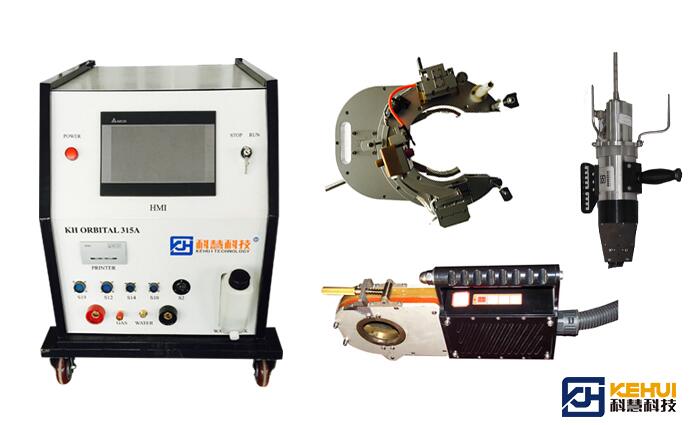
Types of Automatic Welding Machines for Pipeline Field Welding
Orbital Pipe Welder (Closed‑Head)
An orbital pipe welder uses a closed welding head that seals around the pipe. The torch rotates inside a gas‑tight chamber. Perfect gas coverage, no oxidation, consistent results. Ideal for high‑purity applications like pharmaceutical, semiconductor, and food processing—but also used in pipeline welding for root passes where quality is critical.
Our KHGC orbital pipe welder covers tube diameters from 3mm to 180mm.
Open‑Head Orbital Welding Machine
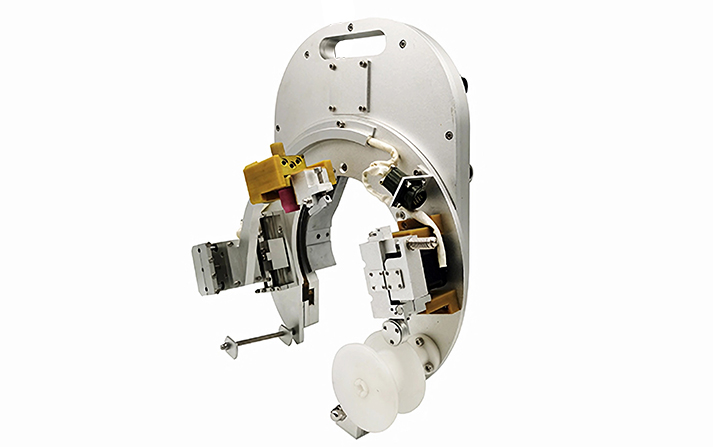
An open‑head automatic welding machine for pipeline clamps around the outside of the pipe. The torch travels along a track. Faster setup, wire feeding capability, wider diameter range. The standard for pipeline construction, petrochemical, and field work.
Our KHGK open‑head automatic welding machine for pipeline handles pipe diameters from 16mm to 300mm.
Welding Carriage (Track‑Mounted)
For large‑diameter pipelines and storage tanks, a welding carriage rides on a track that wraps around the pipe or tank. The automatic girth welding system travels around the circumference, depositing consistent welds on unlimited diameters.
Magnetic carriages adhere to ferromagnetic surfaces. Track‑mounted carriages use rigid or flexible tracks. Soft rails can be custom‑cut to any length—ideal for large tanks and vessels.
Double‑Torch Automatic Pipeline Welding Systems
For high‑volume pipeline construction, double‑torch systems weld two sides simultaneously. They can complete a root pass in approximately 5 minutes. These are the automatic pipe welding solutions used on major oil and gas pipeline projects.
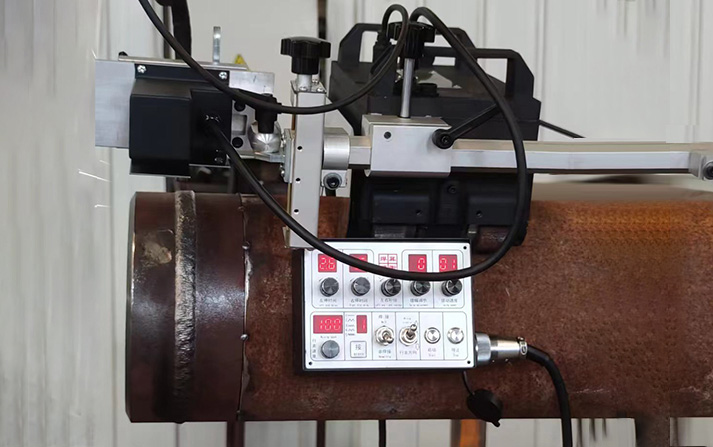
How to Choose an Automatic Welding Machine for Pipeline Field Welding
If you’re evaluating an automatic welding machine for pipeline for field use, here’s what matters:
Environmental rating. Is the automatic welding machine for pipeline rated for dust, moisture, and temperature extremes? Look for IP23 or higher.
Diameter range. Does the orbital pipe welder cover your pipe sizes? Closed heads typically cover up to 180mm. Open heads cover up to 300mm. Welding carriages cover unlimited diameters.
Portability. Can you move the pipeline welding automation system around the job site? Weight, size, and setup time all matter in the field.
Seam tracking. Does the automatic girth welding system adapt to fit‑up variation? Arc‑based seam tracking is essential for real‑world conditions.
Training and support. Who teaches your operators to use the automatic pipe welding solutions? We include engineer‑led on‑site training with every automatic welding machine for pipeline we sell.
Spare parts availability. When something breaks in the field, can you get parts quickly? A China pipeline welding machine manufacturer with a global supply chain makes a difference.
A China Pipeline Welding Machine Manufacturer’s Perspective
We’ve been building automatic welding machine for pipeline systems since 1994. Over thirty years of experience. Exported to more than fifty countries. We’ve seen what works in the field—and what doesn’t.
One of the biggest advantages of choosing a China pipeline welding machine manufacturer is the combination of quality and cost‑effectiveness. The technology gap between Chinese and Western brands has narrowed significantly. Today, a China pipeline welding machine manufacturer like KEHUI offers:
-
Technology comparable to international standards—servo drives, closed‑loop control, data logging, seam tracking
-
Competitive pricing—typically 30‑50% less than European or American equivalents
-
Faster delivery and customization
-
Global experience—our equipment runs in over fifty countries
-
On‑site training—we send engineers to your job site, anywhere in the world
Our KHGK open‑head automatic welding machine for pipeline and KHGC closed‑head orbital pipe welder are field‑proven. We’ve supplied automatic pipe welding solutions to pipeline contractors, pipeline field welding crews, and tank fabricators across five continents.
Real‑World Impact: What Pipeline Field Welding Automation Delivers
Lower rework. Manual pipeline field welding often has rejection rates of 5‑10%. Pipeline welding automation typically cuts that to under 2%. Fewer cut‑outs. Less schedule impact.
Faster welding. An automatic welding machine for pipeline completes each pass faster than manual welding. On large‑diameter pipes with multiple passes, the time savings are dramatic.
Consistent quality. The orbital pipe welder produces the same weld on joint #1 and joint #500. No fatigue. No variation. No “Monday morning” welds.
Lower labor costs. One operator can monitor multiple automatic pipe welding solutions. You don’t need a crew of highly skilled welders for every joint.
Better documentation. Modern pipeline welding automation systems log every parameter—amperage, voltage, travel speed, gas flow. That data is invaluable for quality audits and regulatory compliance.
FAQ
What are the main challenges of pipeline field welding?
Pipeline field welding faces five main challenges: environmental conditions (wind, temperature, humidity), the pipe doesn’t rotate, fit‑up variation (gaps and alignment issues), access limitations (trenches, overhead, inside the pipe), and the shortage of skilled welders.
Can an automatic welding machine for pipeline be used outdoors?
Yes. A modern automatic welding machine for pipeline is designed for field conditions. Many systems are rated IP23 or IP54 for dust and moisture resistance, with operating temperature ranges from −30°C to +60°C. Closed‑head orbital pipe welder designs protect the weld zone from wind, and open‑head systems can be used with wind screens.
What is the difference between an orbital pipe welder and a manual welding machine?
An orbital pipe welder rotates the welding arc around a stationary pipe, maintaining fixed arc length, travel speed, and gas coverage. Manual welding depends on the operator’s skill, which varies with fatigue, experience, and conditions. Pipeline welding automation delivers consistent, repeatable results without the “human error” factor.
How does automatic girth welding improve pipeline construction?
Automatic girth welding completes each pass around the entire circumference without stopping and restarting. This eliminates the weak points where welds start and stop. It also reduces the time per pass, lowers overall project time, and produces higher quality welds since the machine controls all process parameters.
Is automatic pipeline welding faster than manual welding?
Yes. One study comparing orbital welding to manual welding found a total time saving of 66%, including setup and lineup time. On big‑bore pipe welding projects, the time, labor, and cost advantages of automatic pipe welding solutions are exponentially magnified.
How do I choose a pipeline welding machine for field use?
Look for environmental rating (IP23 or higher), diameter range coverage, portability, seam tracking capability, training and support from the manufacturer, and spare parts availability. A China pipeline welding machine manufacturer with global experience and on‑site training can be a cost‑effective choice.
Can a China pipeline welding machine manufacturer provide on‑site training?
Yes. Reputable China pipeline welding machine manufacturer companies like KEHUI provide engineer‑led on‑site training at the customer’s facility—anywhere in the world. We cover travel and training time, and stay until your operators can run the automatic welding machine for pipeline without assistance. Because the best pipeline welding automation system is worthless if your team doesn’t know how to use it.
If you’re looking for an automatic welding machine for pipeline with field‑proven reliability and comprehensive training and support, read our guide [Why Choose KEHUI Orbital Welding Machine].