Stock Code: 831045
Industrial Automation & Intelligence Solutions
SUMMERY: Ask any welding engineer what keeps them up at night, and they won't say machine breakdowns or delivery schedules. They'll say parameters. An orbital TIG welder is only as good as the numbers you punch into it. Get the current wrong, an...
Ask any welding engineer what keeps them up at night, and they won’t say machine breakdowns or delivery schedules. They’ll say parameters.
An orbital TIG welder is only as good as the numbers you punch into it. Get the current wrong, and you burn through. Set the travel speed too fast, and you get lack of fusion. Misjudge the heat input, and your stainless steel weld turns blue—and fails inspection.
We’ve been building orbital TIG welding equipment since 1994. We’ve watched operators chase their tails for days because one parameter was off by 5%. And we’ve seen shops transform their quality overnight once they understood how current, speed, and heat input actually work together.
Here’s what we’ve learned about orbital welding parameters from three decades on the shop floor—not from a textbook.
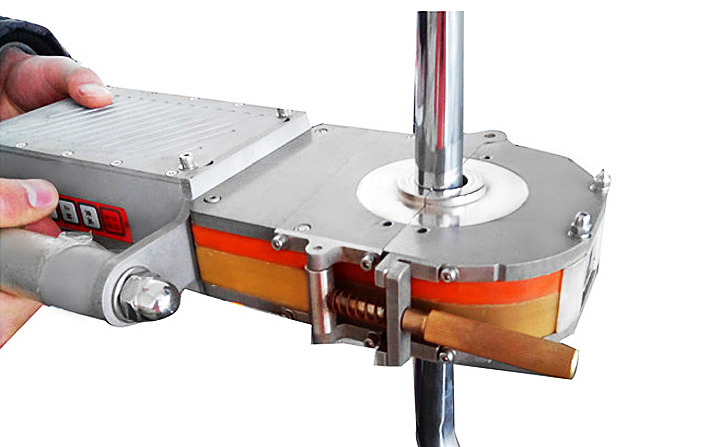
The orbital tig welding process is beautifully simple: a torch rotates 360° around a stationary pipe, depositing a consistent weld. But the variables that control that weld are anything but simple.
Welding current determines how much heat goes into the metal. Too little, and you lack fusion. Too much, and you burn through or distort the pipe. In the orbital welding stainless steel pipe process, current is the dominant control on penetration.
Travel speed determines how long the arc stays over each spot. Too fast, and you don’t get enough penetration. Too slow, and you overheat the material.
Heat input is the product of current, voltage, and travel speed. It’s the master variable that ties everything together—and the one that determines whether your weld passes inspection or gets cut out.
The relationship between these three orbital welding parameters is the difference between a weld that passes inspection and one that ends up in the scrap bin.
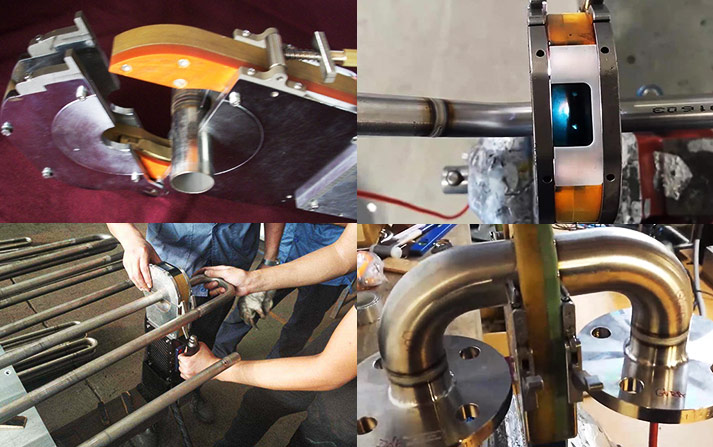
Current is where every orbital TIG welding setup starts. It’s the most influential parameter in the entire orbital tig welding process.
A study on orbital welding stainless steel pipe (304 stainless, 76mm outer diameter, 2mm wall thickness) found that current from 90A to 110A, combined with a fixed travel speed of 5.5 mm/s, produced the best results. The highest tensile strength—562 MPa—was achieved with a heat input of 0.32 kJ/mm.
For sanitary tube welding (38.1mm outer diameter, 1.65mm wall thickness), Taguchi analysis identified the optimal parameter combination as 100A welding current, 1.5mm arc length, and 5 mm/s welding speed.
What this means on the shop floor:
Thin-wall stainless (under 2mm): Start around 90-100A. You’re walking a tightrope—too little and you lack fusion, too much and you burn through.
Thick-wall stainless (over 3mm): You may need 150-170A or more. But watch the heat buildup—high current near the end of the weld can cause blow-hole flaws.
Pulse current: Many modern orbital TIG welder systems use pulsed current—alternating between peak amperage (to melt the base metal) and background amperage (to let the pool cool and stabilize against gravity). This gives you better control on out-of-position welding.
The pro tip: Start low and work up. It’s easier to add current than to fix a burn-through.
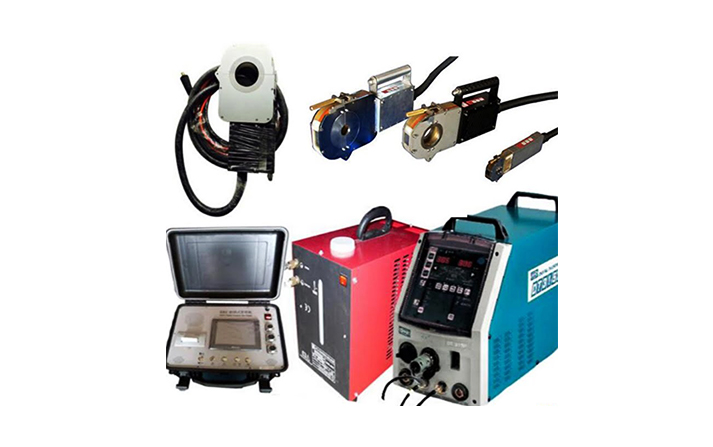
Travel speed is the parameter that operators most often get wrong. It’s counterintuitive: faster isn’t always better, and slower isn’t always safer.
In the orbital tig welding process, travel speed determines the heat input per unit length. Speed that’s too high causes lack of fusion (LOF). Speed that’s too slow increases overall heat input, which can degrade the corrosion resistance of stainless and nickel alloys.
Real-world numbers:
| Application | Travel Speed | Notes |
|---|---|---|
| Sanitary tube (38mm OD, 1.65mm wall) | 5 mm/s | With 100A current |
| 304 stainless (76mm OD, 2mm wall) | 5.5 mm/s | With 90-110A current |
| Thick-wall nuclear piping | 50-75 mm/min (slow) | To prevent LOF |
| Standard stainless pipe | 80-110 mm/min (moderate) | Balance speed and quality |
What this means on the shop floor:
Thin-wall: You can run faster because there’s less metal to melt. But don’t go so fast that you lose fusion.
Thick-wall: Slow down. You need time for the heat to penetrate. 50-75 mm/min is common for heavy-wall applications.
The sweet spot: Most shops find their best results in the 80-110 mm/min range for standard stainless pipe.
The pro tip: Watch the bead. If it’s flat and wide, you’re too slow. If it’s narrow and peaked, you’re too fast. The ideal bead has a gentle crown—not too flat, not too tall.
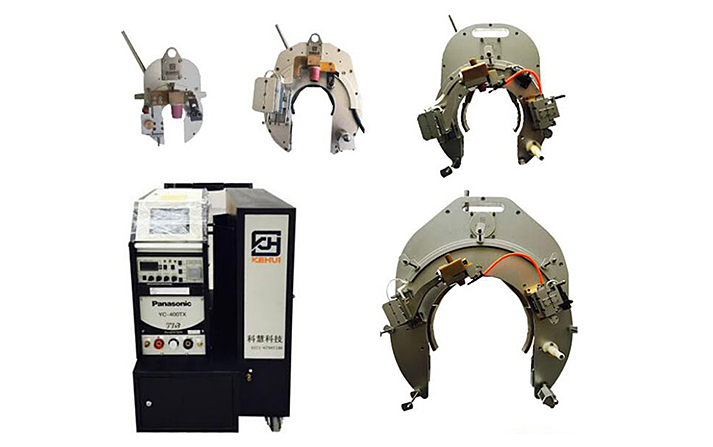
Heat input is the parameter that ties everything together. It’s not something you set directly—it’s the result of current, voltage, and travel speed working together.
The formula is simple:
Heat Input (kJ/mm) = (Voltage × Current × 60) / Travel Speed (mm/min)
Heat input plays a crucial role in enhancing penetration depth within the heat-affected zone (HAZ) of the orbital tig welding process. It also determines heat tint—the discoloration on stainless steel welds that AWS D18.2 strictly regulates.
Too much heat input, and you get:
Excessive heat tint (blue or grey discoloration)
Distortion of the pipe
Degraded corrosion resistance
Too little heat input, and you get:
Lack of fusion
Incomplete penetration
Weak welds
Real-world data:
0.32 kJ/mm produced the highest tensile strength (562 MPa) in 304 stainless pipe welding.
Heat input is the decisive factor for sanitary tube weld quality.
Controlling heat input to achieve complete penetration while maintaining acceptable heat tint is essential.
The pro tip: If you’re welding stainless and seeing blue or grey discoloration, your heat input is too high. Reduce current, increase travel speed, or both. For sanitary applications, AWS D18.2 sets strict limits on heat tint—don’t guess, measure.
The orbital tig welding process is a balancing act. Here’s how current, speed, and heat input interact:
| If you change… | Effect on heat input | Effect on penetration | Effect on speed |
|---|---|---|---|
| Increase current | Increases | Increases | No direct effect |
| Decrease current | Decreases | Decreases | No direct effect |
| Increase speed | Decreases | Decreases | Faster production |
| Decrease speed | Increases | Increases | Slower production |
The challenge is finding the combination that gives you full penetration without excessive heat input.
One study found that welding current affects temperature distribution the most—49.83%—followed by welding speed at 31.53%. Standoff distance had only an 8.83% effect. For tensile strength, welding speed was the dominant factor at 35.19%, followed by current at 21.23%.
The pro tip: When troubleshooting, change one parameter at a time. If you change current and speed together, you won’t know which one fixed the problem—or which one caused it.
Symptoms: A hole in the pipe, or excessive reinforcement on the inside.
Fix: Reduce current (try 90A instead of 100A) or increase travel speed. You need less heat input, not more. For orbital welding stainless steel pipe under 2mm wall, start at the lower end of the range.
Symptoms: The weld looks complete but doesn’t penetrate fully. Cross-section shows a gap at the root.
Fix: Increase current or decrease travel speed. You need more heat input to melt the base metal. Check your arc length too—too long and you lose heat.
Symptoms: Discoloration on the weld surface. On stainless, this means oxidation and compromised corrosion resistance.
Fix: Reduce heat input. Lower the current, increase travel speed, or both. For sanitary applications, AWS D18.2 requires minimal heat tint—keep that heat input under control.
Symptoms: The bead width varies around the circumference.
Fix: Check your arc voltage control (AVC). As the torch orbits the pipe, slight ovality can change the arc gap. AVC measures arc voltage in real time and moves the torch to maintain a constant gap. If your AVC isn’t working, your bead won’t be consistent.
The pro tip: For the orbital tig welding process on stainless, split the circumference into multiple sectors (4 to 12) to account for gravity’s effect on the weld pool. The top of the pipe behaves differently from the bottom.
The three most important orbital welding parameters are welding current, travel speed, and heat input. Current controls penetration, speed controls heat input per unit length, and heat input ties them together. In the orbital tig welding process, these three variables determine weld quality, strength, and appearance.
For orbital welding stainless steel pipe (304 stainless, 2mm wall), start with 90-110A current and 5.5 mm/s travel speed. For sanitary tube (1.65mm wall), 100A current and 5 mm/s speed is optimal. Always run test welds on scrap material first—every batch of pipe behaves slightly differently.
Heat Input (kJ/mm) = (Voltage × Current × 60) / Travel Speed (mm/min). For example, if you’re running 100A, 15V, and 300 mm/min travel speed: (15 × 100 × 60) / 300 = 300 kJ/mm. Studies show 0.32 kJ/mm can achieve 562 MPa tensile strength in 304 stainless.
Blue or grey discoloration (heat tint) means your heat input is too high. In the orbital tig welding process, excessive heat causes oxidation of the chromium in stainless steel, compromising corrosion resistance. Reduce current, increase travel speed, or both. For sanitary applications, AWS D18.2 strictly regulates heat tint levels.
Travel speed determines heat input per unit length. Too fast causes lack of fusion; too slow causes excessive heat that degrades corrosion resistance. For standard stainless pipe, 80-110 mm/min is typical. For heavy-wall applications, slow down to 50-75 mm/min to prevent LOF.
Peak current (Ip) is the high-current phase that melts the base metal. Background current (Ib) is the low-current phase that allows the weld pool to partially solidify and cool. This pulsed current technique keeps the weld pool stable against gravity, especially important for out-of-position welding in the orbital tig welding process.
Studies show welding current has the greatest effect on ultimate tensile strength (UTS), followed by welding speed, pulse time, electrode angle, and torch height. Current directly controls how much heat goes into the weld, which determines penetration depth. In the orbital tig welding process, getting current right is the foundation of everything else.
No. Different diameters and wall thicknesses require different orbital welding parameters. A study on low-carbon steel tubes found optimal parameters varied significantly across Ø48×3.2mm, Ø60×2.6mm, and Ø89×2.9mm pipes. Always qualify procedures for each diameter and wall thickness combination you weld.
If you’re looking for an orbital TIG welder with field-proven reliability and comprehensive training and support, read our guide [Why Choose KEHUI Orbital Welding Machine].
 TAG:
TAG: We value your message!
Please fill the below, We will customized the solution to your needs.