Stock Code: 831045
Industrial Automation & Intelligence Solutions
SUMMERY: If you've ever welded carbon steel pipe, you know the routine. Grind the bevel, set the gap, strike the arc, and pray the wind doesn't blow your shielding gas away. Carbon steel is forgiving—much more than stainless. It conducts heat wel...
If you’ve ever welded carbon steel pipe, you know the routine. Grind the bevel, set the gap, strike the arc, and pray the wind doesn’t blow your shielding gas away. Carbon steel is forgiving—much more than stainless. It conducts heat well, it doesn’t oxidize the way stainless does, and it doesn’t punish you for small mistakes the way exotic alloys do.
But “forgiving” doesn’t mean “easy.” Carbon steel pipe welding still demands precision, especially when you’re welding thick-wall pipe in field conditions. And when you scale up to production volumes, the limitations of manual welding become painfully obvious.
That’s where orbital welding changes the game. An automatic carbon steel pipe welding machine delivers consistent, repeatable welds on every joint—no fatigue, no drift, no “Monday morning” welds.
We’ve been building orbital welding machine for carbon steel pipe systems since 1994. We’ve shipped to over fifty countries. And we’ve learned that the carbon steel pipe welding procedure for orbital welding is different from manual welding—not harder, just different.
Here’s what you need to know about orbital TIG welding carbon steel—from the shop floor, not the textbook.
The first thing to understand about orbital TIG welding carbon steel is that carbon steel doesn’t behave like stainless. And if you treat it like stainless, you’ll get mediocre results.
Carbon steel pulls heat away from the weld zone quickly. This means you need more heat input to achieve the same penetration. Stainless holds heat; carbon steel dissipates it. An automatic carbon steel pipe welding machine needs to account for this with higher current settings or slower travel speeds.
Carbon steel doesn’t require the same level of gas coverage. Stainless needs perfect purge to prevent oxidation. Carbon steel is more tolerant. But that doesn’t mean you can skip the purge—especially on the root pass, where contamination can still cause porosity.
Carbon steel is more forgiving of fit-up variation. Stainless distorts under heat; carbon steel is more stable. This makes the carbon steel pipe welding procedure easier to qualify and more tolerant of real-world field conditions.
Low-carbon steel pipes (carbon content typically below 0.3%) are widely used across construction, oil and gas, water treatment, automotive, manufacturing, and power generation due to their excellent mechanical properties, affordability, and ease of fabrication. They offer a balance between strength, ductility, and weldability that makes them one of the most widely used materials in industrial applications.
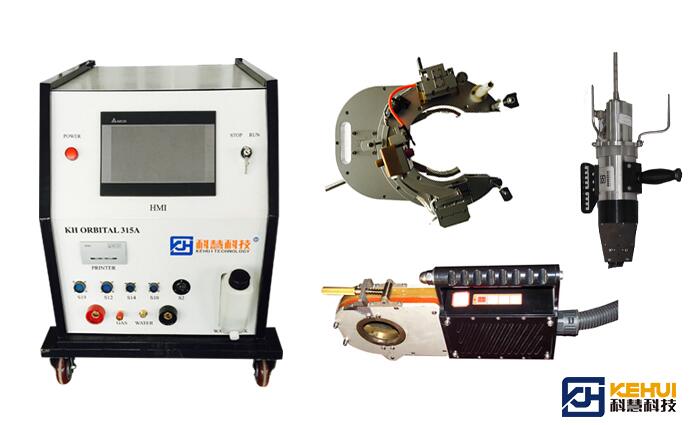
Not every orbital welding machine for carbon steel pipe is the same. The right choice depends on your pipe diameter, wall thickness, and application.
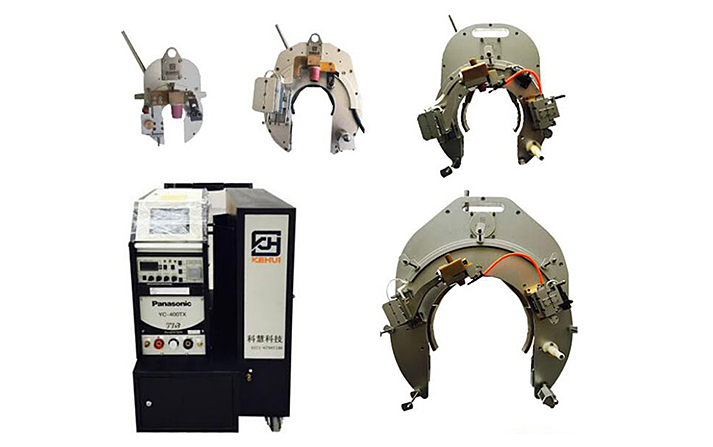
A closed-head automatic carbon steel pipe welding machine seals the weld zone inside a gas-tight chamber. The torch rotates inside the chamber, and inert gas floods the space before and during welding.
Our KHGC series is a closed-head system that covers tube outer diameters from 3mm to 180mm for tube-to-tube automatic welding at all positions. It’s especially suitable for welding carbon steel pipe welding applications with thin walls. The closed head provides consistent gas coverage, making it ideal for root passes where contamination would be catastrophic.
Best for: Small-diameter carbon steel pipes (under 180mm), thin-wall applications, high-purity requirements, and shops that need documented weld quality.
An open-head automatic carbon steel pipe welding machine clamps around the outside of the pipe. The torch travels along a track that wraps the circumference. It supports wire feeding for multi-pass welding and sets up faster than closed heads.
Our KHGK system is an open-head automatic argon arc welding machine specially designed for welding 16-300mm pipe-to-pipe, pipe-to-elbow, pipe-to-flange, and pipe-to-valve body applications. It can be used for carbon steel pipe welding and other materials like alloy steel, stainless steel, and galvanized materials.
Best for: Medium to large-diameter carbon steel pipes (16mm to 300mm), thick-wall applications, field work, and shops that need wire feeding capability.
For large-diameter carbon steel pipes exceeding 300mm—or for storage tank welding—a welding carriage is the best solution. The carriage rides on a track that wraps around the pipe or tank, with the track length customized to the exact circumference.
Best for: Large-diameter carbon steel pipes, storage tanks, field-erected vessels, and applications where clamping a head is impractical.
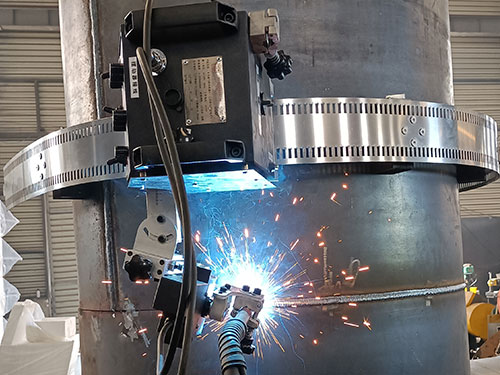
A proper carbon steel pipe welding procedure for orbital welding follows these steps:
The prepared pipe ends must fit together with no gap. Unlike some stainless applications where a small gap is acceptable, carbon steel orbital welding typically uses a no-gap fit-up. The pipe ends are beveled and cleaned to remove oil, grease, and mill scale.
Pro tip: The J bevel (U joint) is the preferred preparation for orbital TIG welding carbon steel. It gives a clean, consistent root with a root face around .060″ and a 20-25° bevel angle. Unlike the V prep, the J prep fits butt to butt with no weld gap.
Before orbital welding, pipes must be positioned and tack welded. For carbon steel, this typically means 4 tacks at equal intervals. The tacks hold the joint in position during the orbital weld.
The carbon steel pipe welding procedure for orbital TIG welding depends on pipe diameter and wall thickness. A study using the Taguchi method (L9) for various diameters of Ø48×3.2mm, Ø60×2.6mm, and Ø89×2.9mm found that variations in tube thickness had a greater impact on weld profile and ultimate tensile strength than changes in diameter.
For SAE 1020 carbon steel tubes, studies have examined the relationship between welding position, constant or pulsed current, and the geometric characteristics of the weld beads. The vertical up position resulted in beads with a lower shape factor and more penetration.
Typical starting parameters for carbon steel orbital welding:
Current: 80-170A depending on wall thickness
Speed: 0.9-5.5 mm/s depending on diameter
Heat input: Controlled to achieve full penetration without excessive HAZ
A study found that welding parameters with a welding current of 170A, a welding speed of 0.9 mm/s, and a welding position of 0° produced an Ultimate Tensile Strength (UTS) increase of 11.01% over the base metal.
The orbital welding machine for carbon steel pipe rotates the torch around the stationary pipe. For thick-wall pipes (over 3mm), multiple passes are required—root, hot pass, fill passes, and cap. The machine controls heat input precisely on every pass.
Constant vs. pulsed current: Studies on orbital TIG welding carbon steel have found that beads welded with pulsed current are more reinforced and wider, as well as being harder and having a finer microstructure.
Weld quality is verified through visual inspection, and for critical applications, non-destructive testing (NDT) methods like radiography or ultrasonic testing.
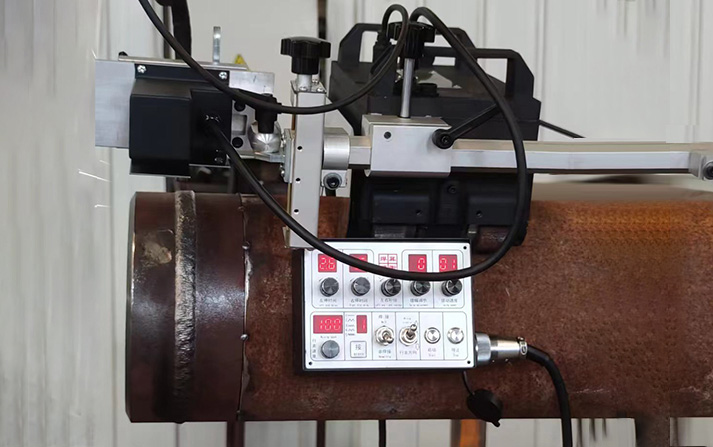
Heat Input (HI) has a significant influence on the mechanical properties and microstructure of both the weld zone and the heat-affected zone (HAZ) in low-carbon steel welds.
The formula is simple:
Heat Input (kJ/mm) = (Voltage × Current × 60) / Travel Speed (mm/min)
Under the same Heat Input levels, variations in tube thickness had a greater impact on weld profile and ultimate tensile strength than changes in diameter. This means that when you’re welding carbon steel pipes, wall thickness matters more than diameter for parameter optimization.
Too much heat input can cause:
Excessive HAZ grain growth
Reduced toughness
Distortion of the pipe
Too little heat input can cause:
Lack of fusion
Incomplete penetration
Weak welds
Partial joint penetration (PJP) welding is widely applied in structural, mechanical, and piping systems where full penetration is not required, offering benefits in cost, time efficiency, and reduced heat input. For critical applications, full penetration is still required.
Symptoms: The weld looks complete but doesn’t penetrate fully. Cross-section shows a gap at the root.
Fix: Increase current or decrease travel speed. For orbital TIG welding carbon steel with thick walls, you need more heat input to achieve full penetration. Check your arc length too—too long and you lose heat.
Symptoms: Small holes or voids in the weld metal.
Fix: Check your shielding gas flow. Carbon steel is more tolerant than stainless, but contaminated gas or inadequate flow still causes porosity. Verify gas purity and flow rate.
Symptoms: The weld penetrates through the pipe wall, creating a drop-through on the inside.
Fix: Decrease current or increase travel speed. For thin-wall carbon steel pipe, start at the lower end of the parameter range.
Symptoms: The bead width varies around the circumference.
Fix: Check your arc voltage control (AVC). As the torch orbits the pipe, slight ovality can change the arc gap. For carbon steel pipe welding with open-head systems, ensure the track is clean and the carriage moves freely.
Symptoms: Cracking or reduced toughness in the area adjacent to the weld.
Fix: Reduce heat input. For orbital TIG welding carbon steel on thick-wall pipe, consider pulsed current to reduce heat input while maintaining penetration.
We’ve been building automatic carbon steel pipe welding machine systems since 1994. Here’s what we’ve learned about carbon steel pipe welding with orbital equipment.
The no-gap fit-up is non-negotiable. Unlike manual welding, where welders can compensate for gaps with technique, an orbital welding machine for carbon steel pipe works best with a consistent, zero-gap joint. If the gap varies, the weld will vary.
Thickness matters more than diameter. A study found that under the same Heat Input levels, variations in tube thickness had a greater impact on weld profile and ultimate tensile strength than changes in diameter. When you’re qualifying carbon steel pipe welding procedures, focus on wall thickness as much as diameter.
Pulsed current gives better results. Studies on orbital TIG welding carbon steel found that beads welded with pulsed current were more reinforced and wider, harder, and had a finer microstructure. If your automatic carbon steel pipe welding machine supports pulsed current, use it.
The vertical up position gives more penetration. For orbital TIG welding carbon steel in vertical position, the vertical up position resulted in beads with a lower shape factor and more penetration.
Don’t skip the purge. Yes, carbon steel is more forgiving than stainless. But on the root pass, internal purge gas is still essential to prevent oxidation and porosity.
Orbital welding of carbon steel pipes is an automated TIG (GTAW) welding process where a welding torch rotates 360° around a stationary pipe. The carbon steel pipe welding procedure uses mechanized weld heads to maintain fixed arc length, travel speed, and gas coverage, producing consistent, repeatable welds. An automatic carbon steel pipe welding machine eliminates the variables that cause defects in manual welding.
A typical carbon steel pipe welding procedure for orbital TIG includes: pipe preparation (beveling and cleaning with no gap fit-up), tack welding to secure the joint, parameter selection (current, speed, heat input based on diameter and wall thickness), welding execution (with constant or pulsed current), and inspection. For orbital TIG welding carbon steel, the J bevel is the preferred groove preparation.
Orbital TIG welding carbon steel parameters vary by diameter and wall thickness. Studies have used welding currents from 80A to 170A and speeds from 0.9 to 5.5 mm/s. One study achieved an 11.01% increase in Ultimate Tensile Strength over the base metal with 170A current and 0.9 mm/s speed. For thin-wall carbon steel pipe, start with lower current and higher speed; for thick-wall, increase current and reduce speed.
The best orbital welding machine for carbon steel pipe depends on your pipe diameter. For small-diameter carbon steel pipes (3-180mm), a closed-head system like the KHGC is ideal. For medium to large-diameter carbon steel pipes (16-300mm), an open-head system like the KHGK with wire feeding capability works best. For very large diameters (300mm+), a welding carriage is the right solution.
Heat Input (HI) has a significant influence on the mechanical properties and microstructure of both the weld zone and the heat-affected zone (HAZ) in low-carbon steel welds. Under the same Heat Input levels, variations in tube thickness have a greater impact on weld profile and ultimate tensile strength than changes in diameter. For carbon steel pipe welding, controlling heat input is essential for achieving the right balance of penetration and weld quality.
Carbon steel pipe welding with an orbital welding machine for carbon steel pipe differs from stainless in several ways: carbon steel conducts heat away from the weld zone quickly, while stainless holds onto it. Carbon steel doesn’t require the same level of gas coverage as stainless, making the carbon steel pipe welding procedure more forgiving. Carbon steel is also more tolerant of fit-up variation and less prone to distortion under heat.
Yes. An automatic carbon steel pipe welding machine is widely used for welding carbon steel pipes in industries including oil and gas, construction, water treatment, power generation, and manufacturing. Orbital TIG welding carbon steel with an automatic system delivers consistent, repeatable results with lower rework rates than manual welding.
If you’re looking for an automatic carbon steel pipe welding machine with field-proven reliability and comprehensive training and support, read our guide [Why Choose KEHUI Orbital Welding Machine].
 TAG:
TAG: We value your message!
Please fill the below, We will customized the solution to your needs.