Stock Code: 831045
Industrial Automation & Intelligence Solutions
SUMMERY: From cross-country transmission pipelines to refinery process lines, every successful pipeline begins with a reliable pipe to pipe joint. In modern oil and gas pipeline construction, thousands of welded joints must meet strict quality an...
From cross-country transmission pipelines to refinery process lines, every successful pipeline begins with a reliable pipe to pipe joint. In modern oil and gas pipeline construction, thousands of welded joints must meet strict quality and safety requirements. A single defective weld can delay construction, increase inspection costs, and affect long-term pipeline reliability.
Today, more contractors are combining qualified welders with an automatic pipeline welding machine to improve consistency and productivity. Understanding different pipe welding joint types, selecting the right welding process, and preparing each pipe to pipe joint correctly are all essential steps for successful oil and gas pipeline construction.
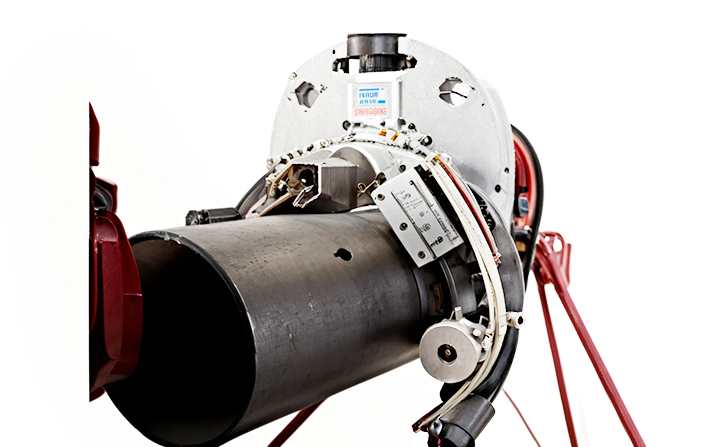
A long-distance pipeline may contain hundreds—or even thousands—of welded connections. Every pipe to pipe joint must withstand pressure, temperature changes, vibration, and years of continuous service.
During oil and gas pipeline construction, engineers focus on three key objectives:
Because of these requirements, choosing suitable pipe welding joint types is just as important as selecting the welding equipment.
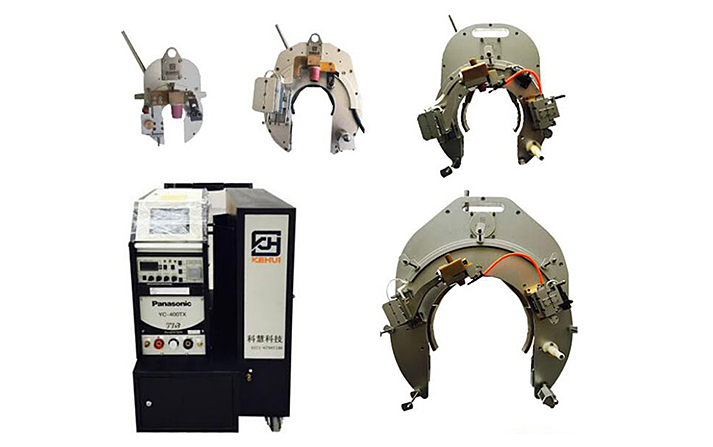
Different applications require different pipe welding joint types.
The butt weld is the most common pipe to pipe joint used in transmission pipelines. It provides excellent strength and is widely used throughout oil and gas pipeline construction.
Typical applications include:
An automatic pipeline welding machine is commonly used for repetitive butt welds because it delivers stable travel speed and repeatable welding parameters.
Socket welds are generally used on smaller-diameter piping systems where installation space is limited.
Although useful in certain applications, socket welds are less common than butt welds in major oil and gas pipeline construction projects.
Some systems require removable connections for maintenance.
Instead of a permanent pipe to pipe joint, flange connections allow equipment such as pumps, valves, and filters to be removed more easily during servicing.
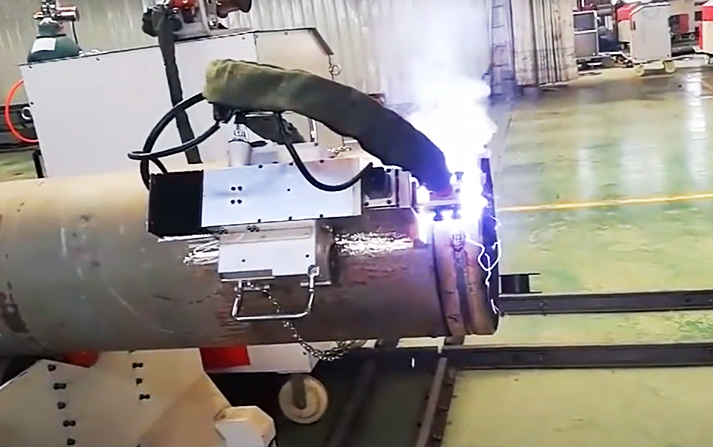
Unlike factory welding, field construction introduces additional pipeline welding challenges.
Common issues include:
These pipeline welding challenges require careful planning before welding begins.
Many contractors now use an automatic pipeline welding machine to reduce variation between operators and maintain consistent welding quality under demanding site conditions.
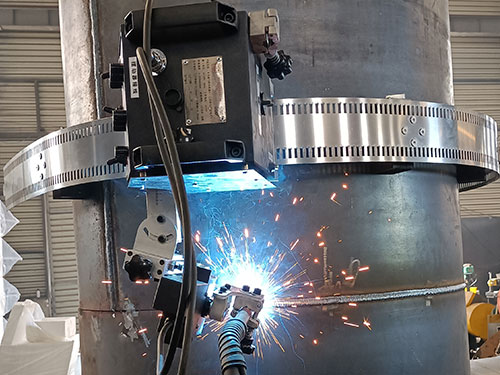
As pipeline projects become larger and schedules become tighter, automation is increasingly adopted across oil and gas pipeline construction.
Compared with manual welding, an automatic pipeline welding machine offers several practical advantages:
| Manual Welding | Automatic Pipeline Welding Machine |
|---|---|
| Operator-dependent | Program-controlled |
| Variable travel speed | Consistent travel speed |
| Greater weld variation | Better repeatability |
| Higher repair rate | Improved first-pass quality |
| Longer production time | Higher productivity |
For projects involving hundreds of similar pipe to pipe joint operations, automation helps improve production consistency while reducing unnecessary rework.
Not every pipeline has the same dimensions.
In many transmission projects, large diameter pipe welding requires external welding systems, welding carriages, or multi-pass welding procedures.
Compared with small process piping, large diameter pipe welding often involves:
An automatic pipeline welding machine configured for large diameter pipe welding can help maintain stable travel speed throughout the circumference, improving weld consistency.
There is no single solution for every pipeline.
When choosing pipe welding joint types, engineers normally evaluate:
High-pressure systems generally favor butt-welded pipe to pipe joint designs.
Different diameters may require different joint preparation methods and welding procedures.
Carbon steel, stainless steel, duplex stainless steel, and alloy steel each require qualified welding procedures.
Radiographic testing, ultrasonic testing, and pressure testing all influence joint design and welding quality requirements.
Selecting suitable pipe welding joint types early in the project helps improve efficiency throughout oil and gas pipeline construction.
Experienced contractors often achieve better results by focusing on process control rather than simply increasing welding speed.
Recommended practices include:
Combined with an automatic pipeline welding machine, these practices help reduce common pipeline welding challenges and improve project quality.
Successful oil and gas pipeline construction depends on more than choosing a welding machine.
Reliable projects combine:
When these elements work together, every pipe to pipe joint contributes to a safer and more reliable pipeline system.
Every stage of oil and gas pipeline construction depends on the quality of each pipe to pipe joint. Selecting appropriate pipe welding joint types, preparing joints correctly, and applying an automatic pipeline welding machine where suitable can improve productivity, weld consistency, and long-term pipeline performance.
As projects continue to expand in scale, automation is becoming an increasingly important part of modern pipeline construction. Whether the application involves standard process piping or large diameter pipe welding, choosing the right welding approach is essential for achieving reliable results.
Answer: The butt weld is the most widely used pipe to pipe joint because it provides high strength, excellent pressure resistance, and is suitable for long-distance oil and gas pipeline construction.
Answer: The most common pipe welding joint types include butt weld joints, socket weld joints, flanged connections, and threaded joints. The selection depends on pressure, pipe size, material, and maintenance requirements.
Answer: An automatic pipeline welding machine helps improve weld consistency, reduce operator variation, increase productivity, and support higher first-pass inspection rates on repetitive pipeline projects.
Answer: Typical pipeline welding challenges include wind, dust, uneven terrain, pipe alignment, changing weather conditions, and maintaining consistent welding quality across long pipeline sections.
Answer: Yes. Large diameter pipe welding usually requires multi-pass welding procedures, higher heat input control, and specialized equipment such as external welding systems or welding carriages.
Answer: The choice of pipe welding joint types should consider operating pressure, pipe diameter, wall thickness, material, inspection requirements, and the overall construction environment.
Answer: Many modern automatic pipeline welding machine systems support multiple pipe diameters with the appropriate welding heads, fixtures, or accessories. The final configuration should be selected according to the project’s pipe specifications and production requirements.
 TAG:
TAG: We value your message!
Please fill the below, We will customized the solution to your needs.