Stock Code: 831045
Industrial Automation & Intelligence Solutions
SUMMERY: I remember walking through a boiler fabrication shop in Pennsylvania a few years ago. The production manager stopped me in front of a massive tubesheet—over two meters across, with hundreds of tube holes staring back at us. “Every one of...
I remember walking through a boiler fabrication shop in Pennsylvania a few years ago. The production manager stopped me in front of a massive tubesheet—over two meters across, with hundreds of tube holes staring back at us. “Every one of those joints,” he said, “has to hold 1,500 psi of steam. And I’ve got eight weeks to get this boiler out the door.”
He was welding them manually with TIG. His welders were good—really good. But by the end of the second shift, fatigue was setting in. Arc lengths drifted. Travel speeds varied. The reject rate was creeping toward 10%.
That shop doesn’t weld boiler tubes by hand anymore. They found a better way—tube to tubesheet orbital welding.
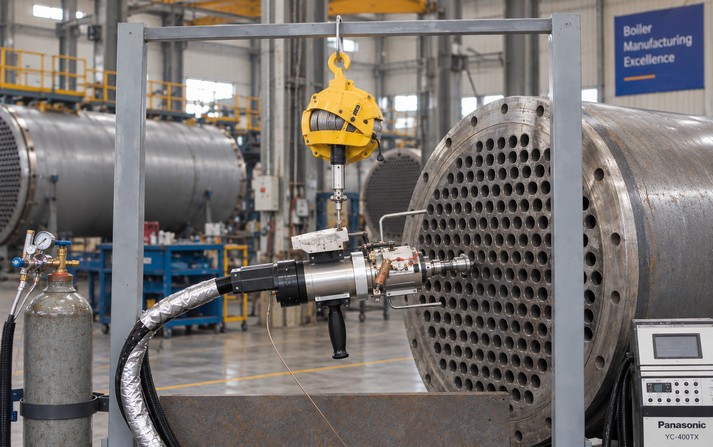
Industrial boiler pipe welding is among the most demanding fabrication tasks in manufacturing. Power boilers operate at pressures exceeding 3,000 psi and temperatures above 1,000°F. The tubes expand and contract with every thermal cycle. Every tube to tubesheet orbital welding joint has to be near-perfect—and there can be thousands of them in a single boiler.
The tube-to-tubesheet joint is the highest-density welding operation in boiler manufacturing. A single large shell-and-tube boiler may contain over 1,000 tube-to-tubesheet joints. That’s a lot of opportunities for things to go wrong.
Common defects in manual industrial boiler pipe welding include porosity, lack of fusion, incomplete penetration, and cracking. These aren’t cosmetic issues. In one documented case, boiler pipe failure was caused by erosion combined with welding defects—porosity and incomplete penetration were the culprits. A single failed joint can erode adjacent tubes, cascade into multiple failures, and shut down a plant for weeks.
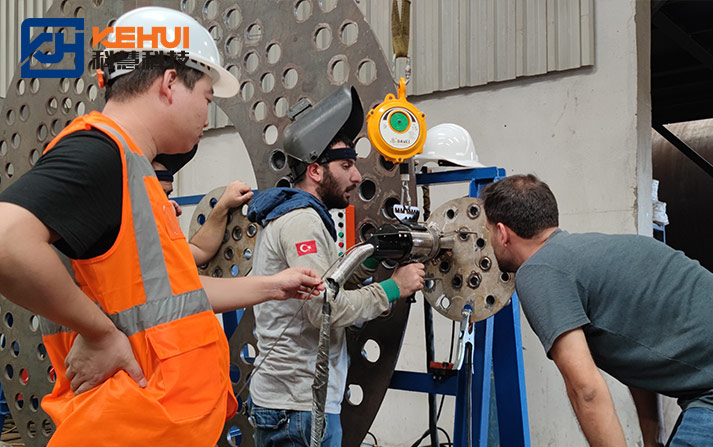
Here’s what I see on shop floors all the time: a skilled welder producing beautiful welds on the first 50 tubes. Then fatigue sets in. Their arm shakes. Their torch angle drifts. Travel speed fluctuates.
Manual welding of boiler tubes suffers from several inherent problems:
Arc length drifts. As the welder orbits around the tube, the distance between the tungsten and the workpiece changes. When the arc gets too long, heat input drops and penetration suffers. When it gets too short, you risk tungsten inclusion or burn-through.
Travel speed varies. Every variation changes the weld profile. Some joints get full penetration, some don’t.
The puddle fights gravity. At the bottom of the tube, the weld pool wants to sag. At the top, it wants to run thin. Even skilled welders can’t compensate perfectly every time.
Gas coverage gets disrupted. When the torch angle changes, air can enter the weld zone, causing porosity.
Research shows that in power boiler tubing, gas pores from incomplete penetration or unstable puddle are the main weld defects. These create stress concentrations that, under thermal cycling, develop into crack initiation sites.
Common defects in industrial boiler pipe welding include lack of fusion, incomplete penetration, severe porosity, and cracking. One shop we worked with was scrapping nearly 12% of their tube-to-tubesheet joints because of inconsistent penetration. The welders were certified and experienced—but the job itself was simply too demanding for human consistency.
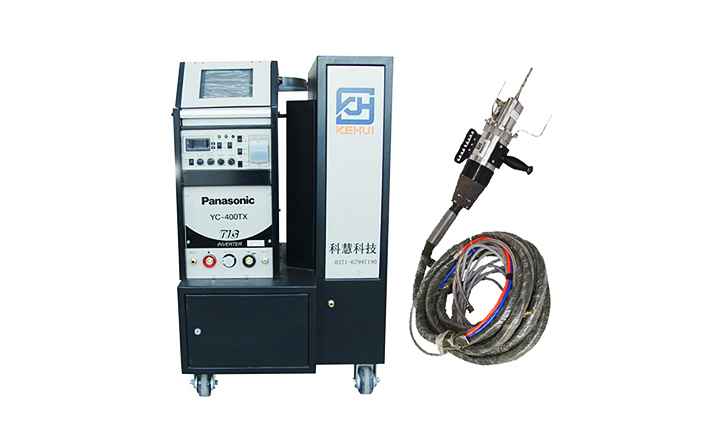
Now consider the alternative. Tube to tubesheet orbital welding mechanically rotates the arc 360° around a stationary tube. The welding head centers itself on the tube ID using expanding mandrels, keeping the tungsten perfectly concentric.
Here’s why that changes everything for industrial boiler pipe welding.
Consistency. A tube to tubesheet orbital welding system maintains constant arc length electronically. Travel speed is governed by precision gearing, not by how fast the welder can rotate their wrist. Current pulses according to a schedule developed for that specific material and wall thickness. Orbital welding equipment guarantees that approved weld sequences are reliably repeated, hence time-consuming repair work will be reduced to a minimum. Every weld is identical to the last—something even master manual welders can’t match.
Productivity. One operator can manage multiple weld heads simultaneously. Compared to manual welding, mechanized or automated processes increase productivity significantly. The orbital welding machine for boiler tubes doesn’t need breaks. It doesn’t get tired. It runs all shift, every shift.
Access. Weld heads can be positioned in rows of boiler tubing where it would be difficult for a manual welder to even see the joint, let alone weld it. The head fits into tight spaces, centers automatically, and delivers shielding gas exactly where it’s needed.
Reduced rework. When every weld is identical and defect-free, rework drops dramatically. Fabricators who switch from manual to automated tube to tubesheet orbital welding typically see reject rates drop from double digits to under 2%.
The orbital welding process is characterized by high quality weld beads and good repeatability. Once a successful weld cycle is memorized, it can be repeated as often as necessary—the result always remains the same: the production of a faultless joint.
A proper boiler tube sheet welding machine for industrial applications includes several key features.
Tube diameter range. Most systems handle tube diameters from 12 mm to 80 mm, with custom options available. The tube to tubesheet welding machine factory that builds these systems typically offers customization for non-standard sizes.
Joint configurations. The boiler tube sheet welding machine must support flush, protruding, and recessed tube ends. It should handle both autogenous (fusion-only) and filler-wire welding.
Cooling. Water-cooled heads prevent overheating during extended production runs. This is critical in industrial boiler pipe welding, where you might be welding hundreds of tubes per shift.
Programmability. The orbital welding machine for boiler tubes should store multiple weld schedules for different tube sizes, materials, and joint configurations. Operators select the appropriate program, and the system sets all parameters automatically.
Data logging. Traceability is increasingly important for ASME compliance. The boiler tube sheet welding machine should record parameters for every weld.
Our KHB12-80 tube to tubesheet orbital welding system is designed specifically for these requirements. It supports tube diameters from 12 mm to 80 mm, features a Panasonic IGBT inverter power source, and includes a water-cooled TIG torch with a 16-liter stainless steel water tank. The entire system is mounted on an integrated mobile cart for flexible deployment.
Industrial boiler pipe welding covers a wide range of applications, each with its own challenges. Tube to tubesheet orbital welding adapts to all of them.
Power plant boilers. Superheater and reheater tubing systems use thin-walled tubes that require precise heat input control. Too much heat and you burn through. Too little and you get incomplete fusion. An orbital welding machine for boiler tubes delivers the exact heat input every time.
Feedwater heaters. These pressure vessels operate at high pressures and temperatures. Every joint must be a full-strength weld that can withstand thermal cycling without cracking. Research from ASME shows that welded-and-expanded joints should be full-strength expanded, and expansion length should equal the tubesheet thickness minus 1/8 inch.
Waste heat boilers. Used in refineries and chemical plants, these units have massive tubesheets with thousands of tubes. Manual welding would take weeks and still produce unacceptable reject rates. A boiler tube sheet welding machine with multiple heads can complete a bundle in days.
Nuclear steam generators. Every weld must be documented and traceable. An automated system provides the data logging required for code compliance.
If you’re fabricating boilers for the North American market, you’re working to ASME codes. Section I of the ASME Boiler and Pressure Vessel Code provides rules for the construction of power boilers, including permitted materials, design, fabrication, and welding.
Qualifying a industrial boiler pipe welding procedure under ASME Section IX involves welding mock-ups, sectioning them, and examining macro-etch samples to verify penetration and freedom from defects. For strength welds, the cross-section must show that the weld throat meets or exceeds the design requirement.
Manual welding makes it hard to consistently reproduce a qualified procedure across hundreds of joints. An automated tube to tubesheet orbital welding system executes the qualified procedure exactly the same way every time—no Friday afternoon drift.
Working with a reputable tube to tubesheet welding machine factory ensures you get equipment that meets these demanding standards. The best factories don’t just build machines—they understand the codes, the materials, and the real-world challenges of boiler fabrication.
We build boiler tube sheet welding machine systems. Every week, we get calls from boiler fabricators frustrated with manual welding. They’ve tried different filler metals, different preheat, different welders. Nothing fixes the inconsistency.
We invite them to our facility, run samples on their material, and show them the difference. They see perfect fusion, consistent penetration, no porosity. Then we design a tube to tubesheet orbital welding system for their specific tube sizes and joint geometries.
Within a month, their reject rates drop, their throughput increases, and their welders stop dreading tube bundles. One customer was building large power boilers with thousands of tubes per unit. After switching to our orbital welding machine for boiler tubes, their reject rate dropped from 8% to under 1%. The equipment paid for itself in rework savings within six months.
Industrial boiler pipe welding is too critical for guesswork. Every joint carries load, resists pressure, and endures thermal cycles. Manual welding can’t deliver the consistency required for reliable, long-lasting boilers. Tube to tubesheet orbital welding can.
The orbital welding machine for boiler tubes eliminates the variability that causes defects. It increases productivity. It reduces rework. It gives you confidence that every joint in every bundle meets code requirements.
If you’re still welding boiler tubes by hand, ask yourself: how much rework are you accepting? How many field failures are you risking? How much productivity are you losing?
The answers will point you toward a better boiler tube sheet welding machine.
Q: What makes tube to tubesheet orbital welding better than manual TIG for industrial boiler pipe welding?
Consistency. Manual industrial boiler pipe welding varies with the welder’s fatigue and technique. Tube to tubesheet orbital welding uses a mechanized head that maintains constant arc length, travel speed, and heat input on every weld. The result is uniform penetration and defect-free joints, which you simply can’t get with manual methods.
Q: Is a boiler tube sheet welding machine cost-effective for smaller fabrication shops?
Yes, even for smaller shops. If you weld more than 500 tubes per year, the savings from cutting reject rates from 10% to under 2% will cover the equipment investment within 12–18 months. Plus, you gain the ability to bid on higher-quality jobs that demand automation. Working with a tube to tubesheet welding machine factory that offers flexible configurations can also help manage upfront costs.
Q: What tube diameters can an orbital welding machine for boiler tubes handle?
Most orbital welding machine for boiler tubes systems handle tube diameters from 12 mm to 80 mm, with custom options available for smaller or larger sizes. Some specialized systems can go down to 10 mm for instrument tubing or up to 100 mm for large boiler tubes.
Q: Can tube to tubesheet orbital welding handle different boiler tube materials?
Absolutely. Tube to tubesheet orbital welding systems work with carbon steel, stainless steel, chrome-moly alloys, nickel alloys, and titanium. You program schedules for each material and wall thickness. For dissimilar joints—like stainless tubes to carbon steel tubesheets—the system controls dilution with precise pulse parameters and filler wire.
Q: What ASME requirements apply to industrial boiler pipe welding?
ASME Section I covers power boilers. Tube-to-tubesheet attachments must meet specific size and quality criteria. Procedures are qualified per ASME Section IX, including macro-etch examination of mock-ups. A boiler tube sheet welding machine helps you consistently reproduce the qualified procedure, ensuring code compliance on every joint. Research from ASME shows that welded-and-expanded joints should be full-strength expanded.
Q: How long does it take to train operators on a boiler tube sheet welding machine?
Typically one week. The skill shifts from torch manipulation to programming, setup, and monitoring. Most certified welders adapt quickly—they already understand weld metallurgy and procedure. A good tube to tubesheet welding machine factory provides on-site training to get your team productive fast.
Q: What’s the most common failure mode in manual industrial boiler pipe welding?
Incomplete fusion or penetration at the tube-to-tubesheet interface. This creates a weak spot that cracks under thermal fatigue. Manual industrial boiler pipe welding is prone to this because arc length and travel speed vary. Tube to tubesheet orbital welding eliminates those variables, giving you full fusion every time.
 TAG:
TAG: We value your message!
Please fill the below, We will customized the solution to your needs.