Stock Code: 831045
Industrial Automation & Intelligence Solutions
SUMMERY: Boiler tube welding is a demanding process in boiler, heat exchanger, and power-generation equipment manufacturing. A typical boiler may contain hundreds or thousands of tube connections, and every tube to tubesheet joint must withstand ...
Boiler tube welding is a demanding process in boiler, heat exchanger, and power-generation equipment manufacturing. A typical boiler may contain hundreds or thousands of tube connections, and every tube to tubesheet joint must withstand pressure, thermal cycling, vibration, and long-term operating conditions.
TIG remains widely used because of its precise arc control and clean weld formation. However, when TIG welding boiler tubes is repeated hundreds of times, operator fatigue and differences in torch movement can affect consistency. This is where automated boiler tube welding and a dedicated tube to tubesheet welding machine can provide a practical production advantage.
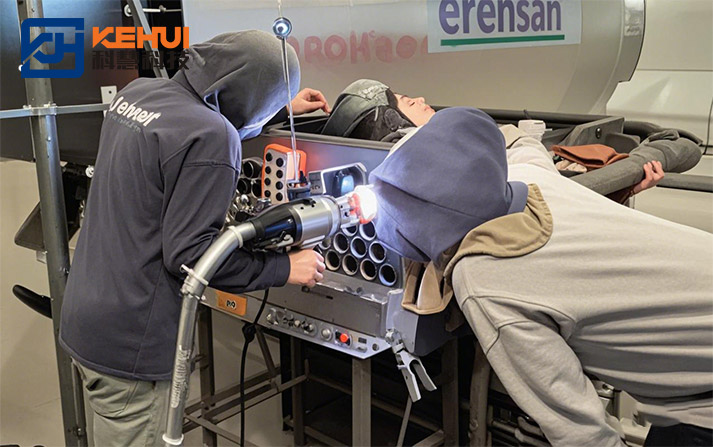
A boiler tube sheet normally contains a dense pattern of holes, leaving limited space between adjacent tubes. During manual welding, the operator must maintain the correct torch angle, arc length, and travel speed while working in a confined area.
This becomes increasingly difficult as the number of tube to tubesheet joint connections increases. A welding technique that works well for several joints may become much harder to maintain consistently across an entire tube sheet.
Boiler tubes can be manufactured from carbon steel, stainless steel, low-alloy steel, and heat-resistant alloys. Each material requires appropriate control of current, travel speed, shielding gas, and heat input.
During boiler tube welding, excessive heat can increase distortion or affect material properties, while insufficient heat may cause incomplete fusion. This is why TIG welding boiler tubes requires not only a skilled operator but also stable process parameters.
Consider a factory producing a feedwater heater with several hundred tube-to-sheet connections. The first group of welds may be highly consistent, but after hours of repetitive work, fatigue can affect torch movement.
A small change in arc length, torch angle, or travel speed can alter penetration and bead geometry. These variations may not always be visible immediately but can become important during pressure or leak testing.
The limitation of manual boiler tube welding is therefore often not TIG itself, but the difficulty of reproducing exactly the same welding movement over a large number of joints.
Large-scale boiler tube sheet welding requires operators to repeatedly bend, reach, reposition, and inspect the welding area. The working position may also change from one section of the tube sheet to another.
Automation transfers this repetitive torch movement to the machine while the operator focuses on setup, monitoring, and quality control.
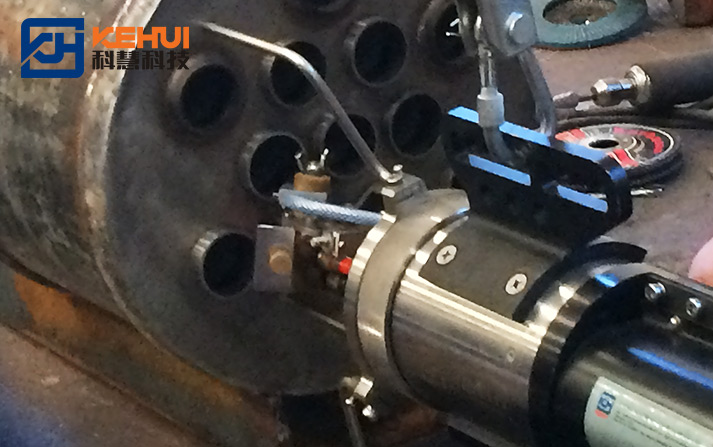
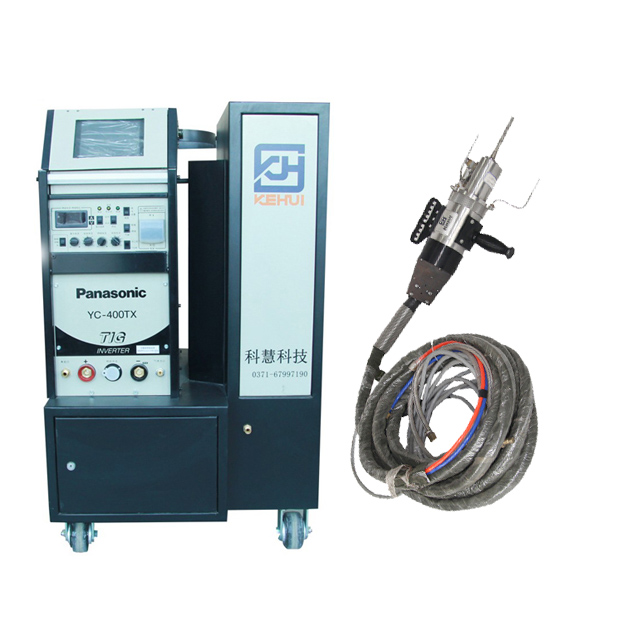
A modern tube to tubesheet welding machine can integrate a TIG power source, precision welding head, and programmable control system.
Depending on the configuration, it can control:
Instead of manually reproducing the same movement hundreds of times, the operator can establish a qualified welding program and repeat it across similar joints.
The biggest benefit of a tube to tubesheet welding machine is not necessarily faster welding. For many factories, repeatability is more important.
If a tube sheet contains 800 joints, the manufacturer wants the 800th weld to be as predictable as the first. Automated welding reduces variation caused by operator fatigue, inconsistent movement, and different working positions.
Orbital welding for boiler tubes uses controlled rotational movement around the tube circumference. Instead of manually guiding the torch around the joint, the welding head follows a programmed path.
During manual TIG, the operator controls torch position, travel speed, arc length, and heat input simultaneously.
With orbital welding for boiler tubes, mechanical movement is controlled by the welding system. Once the welding head is correctly positioned, the torch can maintain a consistent path around the tube.
For a tube to tubesheet joint, this helps produce more uniform weld geometry from one connection to the next.
Orbital welding for boiler tubes is particularly useful when manufacturers have:
Automation cannot compensate for poor tube preparation or incorrect fit-up. Successful boiler tube sheet welding also depends on the condition of the tube and tube sheet.
Tube ends and tube sheet bores should be clean and free from oil, moisture, oxide, and other contaminants. Tube projection should also be controlled to ensure consistent welding head positioning.
A tube to tubesheet joint requires proper alignment between the tube OD and tube sheet bore. Excessive clearance or inconsistent tube projection can make weld formation less stable.
For this reason, automated welding should be combined with controlled machining, cleaning, and tube installation procedures.
The required welding method depends on the function of the connection.
A seal weld is primarily designed to prevent fluid leakage, while a strength weld contributes to the mechanical connection between the tube and tube sheet.
The selected tube to tubesheet welding machine should therefore match the required joint configuration rather than simply producing a visually acceptable weld.
When selecting a tube to tubesheet welding machine for boiler production, manufacturers should consider:
The welding head must fit the tube pitch and provide sufficient access around the joint. Tube diameter and tube sheet thickness should also fall within the machine’s working range.
For precision applications, pulsed TIG can provide accurate control of heat input and arc characteristics. When TIG welding boiler tubes, stable current control and programmable parameters are particularly important.
A programmable welding system allows qualified parameters to be stored and reused across similar joints. This reduces dependence on manually reproducing the same welding cycle.
Automated boiler tube welding can be used in a variety of power and heat-transfer equipment, including:
Applications include condensers, feedwater heaters, economizers, heat recovery equipment, and other heat-transfer assemblies.
Nuclear-related heat exchange equipment requires strict control of welding procedures, inspection, traceability, and repeatability. Automation can help manufacturers achieve more consistent repetitive welding operations when used within the applicable qualified procedures.
Industrial steam boilers, waste heat boilers, and process heat exchangers can also contain large numbers of tube-to-sheet connections, making automation attractive for repetitive production.
The transition from manual to automated boiler tube welding is mainly driven by repeatability and production control.
For a small number of special joints, manual TIG may remain practical. However, when the same connection must be produced hundreds or thousands of times, a tube to tubesheet welding machine can provide significant advantages:
The real value of automation is therefore not simply making welding faster. It is making the welding process more predictable and repeatable.
Answer: The main advantage is repeatability. Automated boiler tube welding can control torch movement and welding parameters more consistently than manual operation.
Answer: Yes. Orbital welding for boiler tubes is well suited to repetitive circumferential tube connections because the welding head can maintain controlled movement around the tube.
Answer: A tube to tubesheet welding machine automates welding between tubes and a tube sheet. Typical applications include boilers, condensers, feedwater heaters, and heat exchangers.
Answer: Manual TIG welding boiler tubes depends heavily on the operator maintaining consistent torch angle, arc length, travel speed, and heat input. Fatigue can increase variation during long production runs.
Answer: Tube projection, fit-up, surface cleanliness, material compatibility, welding parameters, shielding gas, heat input, and torch positioning all affect a tube to tubesheet joint.
Answer: Important factors include tube diameter, tube pitch, tube sheet thickness, welding head accessibility, TIG power source, programmable controls, and whether the application requires seal or strength welding.
 TAG:
TAG: We value your message!
Please fill the below, We will customized the solution to your needs.