Stock Code: 831045
Industrial Automation & Intelligence Solutions
SUMMERY: Quenching oil plays an important role in industrial heat treatment. Its cooling characteristics affect how heat is removed from metal components during quenching. However, the actual cooling performance of an oil cannot be reliably judge...
Quenching oil plays an important role in industrial heat treatment. Its cooling characteristics affect how heat is removed from metal components during quenching. However, the actual cooling performance of an oil cannot be reliably judged by its appearance or supplier specifications alone.
For heat treatment plants, quenching oil manufacturers, and testing laboratories, cooling curve testing provides an objective method for evaluating quenching oil performance. By recording how a standardized heated probe cools in the oil, technicians can obtain temperature-time and cooling rate curves for further analysis.
This article explains how to measure a quenching oil cooling curve, interpret the test results, understand relevant international standards, and select suitable testing equipment.
A quenching oil cooling curve is a graphical record of how the temperature of a heated test probe changes over time after immersion in quenching oil under specified test conditions.
During testing, a standardized metal probe equipped with a temperature sensor is heated according to the selected test method and then transferred into the quenching oil. The measurement system continuously records its temperature during cooling.
The test produces two main types of data:
Two oils may have similar total cooling times but different cooling rate curves. One may cool faster within a particular temperature range, while the other follows a different cooling pattern. Therefore, analyzing the complete quenching oil cooling curve is more informative than comparing only one cooling time or maximum cooling rate.
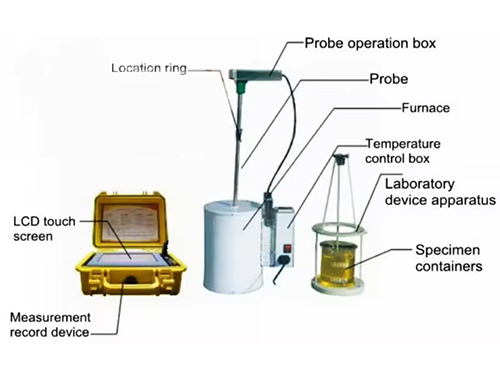
Reliable quenching oil cooling rate measurement depends on the probe, oil sample, temperature acquisition system, and testing procedure. These factors must be controlled to obtain comparable results.
Collect a representative oil sample and check its condition before testing. Water contamination, foreign particles, and inconsistent sample handling may affect the results.
When comparing new oil with oil already in service, both samples should be tested under the same conditions.
The probe is a critical part of cooling rate measurement. Standardized tests use a specified metal probe with a temperature sensor, commonly a thermocouple.
Its material, dimensions, surface condition, and sensor installation can influence measurement consistency. The probe should meet the requirements of the applicable test method.
Heat the probe according to the selected standard. Initial temperature, heating procedure, and transfer time should be controlled because they affect the subsequent cooling process.
Transfer the heated probe into the oil and continuously record its temperature.
Oil temperature, probe positioning, immersion procedure, and agitation must follow the applicable method. ASTM D6200, for example, specifies conditions for evaluating quenching oil cooling characteristics.
The recorded temperature data are used to generate time-temperature and cooling rate curves.
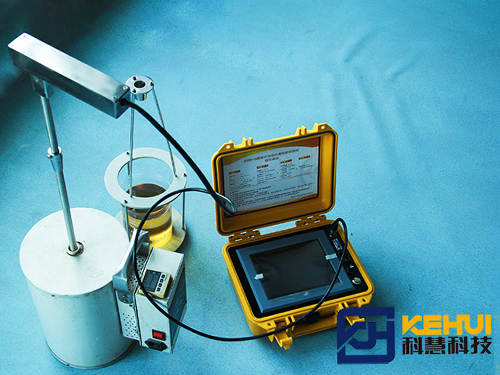
A suitable quenchometer should allow users to record, display, and review the test results consistently. These curves can then support oil sample comparisons and heat treatment process evaluation.
Obtaining a curve is only the first step. Engineers also need to understand what the data indicate.
The maximum cooling rate represents the highest temperature reduction rate recorded during testing. It is useful for comparing different oils under the same test conditions.
However, a higher maximum cooling rate does not automatically mean better performance. The appropriate cooling behavior depends on steel grade, component geometry, hardening requirements, and the risk of distortion or cracking.
The temperature at which the maximum cooling rate occurs provides additional information about the oil’s cooling behavior.
Two oils may have similar maximum cooling rates but reach those rates at different temperatures. This is why cooling rate measurement should consider both the rate value and its corresponding temperature.
Heat transfer during quenching may involve vapor-film formation, nucleate boiling, and convection. Their relative importance depends on the quenching medium and test conditions.
When analyzing a cooling rate curve, technicians should examine how cooling behavior changes across the temperature range rather than assuming every oil follows an identical pattern.
One practical application of cooling curve testing is comparing:
For meaningful comparisons, sample preparation, probe specifications, initial temperature, and testing conditions should remain consistent.
Differences between curves may indicate changes in cooling behavior caused by oil aging, contamination, formulation, or operating conditions. Further investigation is needed to identify the actual cause.
Industrial heat treatment plants need to know whether their quenching medium continues to perform as expected. Visual inspection alone cannot provide a complete assessment.
A quenchometer helps technicians evaluate cooling characteristics using recorded test data.
Cooling curve data can help engineers compare different quenching oils and assess whether their cooling characteristics suit a particular heat treatment application.
Oxidation, contamination, water ingress, and other operating factors may affect quenching oil properties. Periodic quenching oil testing can help identify changes in cooling behavior.
In gear heat treatment, bearing heat treatment, and steel component manufacturing, consistent quenching conditions are important.
Cooling curve data provide useful information when engineers investigate variations in hardness, distortion, or other heat treatment results. However, a cooling curve test does not directly measure workpiece hardness or determine the cause of every defect. Material composition, heating temperature, holding time, component geometry, and quenching conditions also matter.
International standards help laboratories obtain consistent and comparable cooling characteristic data.
ASTM D6200 is a test method for determining the cooling characteristics of quenching oils using a specified probe and controlled procedure.
It is commonly referenced when evaluating and comparing heat treatment oils. Its scope is associated with quenching oil testing and should not be generalized to every water-based quenchant or polymer solution.
ISO 9950 describes a method for determining the cooling characteristics of industrial quenching oils using a nickel-alloy test probe.
Like ASTM D6200, it provides a standardized approach to cooling characteristic measurement. Laboratories should follow the applicable standard edition and its specified requirements.
Buyers should check whether the instrument and its test configuration support the methods required by their laboratories.
KHR-A supports ASTM D6200 and ISO 9950 testing requirements, as confirmed by Kehui’s engineering team. Buyers should verify the applicable probe, accessories, software functions, and test configuration.
Supporting a test method does not automatically mean holding third-party certification or accreditation. Laboratories remain responsible for following the standard and maintaining appropriate testing procedures.
For laboratories and heat treatment manufacturers, the testing instrument is an important part of the measurement system.
KHR-A Quenchometer, developed and manufactured by Zhengzhou Kehui Technology Co., Ltd., is designed to measure the cooling characteristics of quenching media and analyze cooling curve data.
Its main applications include:
Zhengzhou Kehui Technology Co., Ltd. was established in 1994. The company has long-term experience in developing and manufacturing quenching testing instruments, with a technical background focused on this field.
According to Kehui’s historical company information, its quenching testing instruments had achieved approximately 90% market coverage in China around ten years ago. This is a historical company-reported figure, not a claim about current global market share.
Today, Kehui is expanding its overseas business and introducing the KHR-A Quenchometer to international heat treatment laboratories, quenching oil manufacturers, and industrial users.
For customers researching ivf SmartQuench, IVF Quenchtest, or other established quenching measurement equipment, comparing test methods, probe configurations, software functions, and technical support is important.
KHR-A is Kehui’s own quenching testing instrument. It offers an additional option for buyers evaluating quenchometers for their laboratory requirements. Product specifications and compatibility should always be verified against the respective manufacturer’s documentation.
When selecting a quenchometer, buyers should look beyond the product name and advertised functions.
| Evaluation point | What buyers should check |
|---|---|
| Test standards | Does it support ASTM D6200 or ISO 9950 as required? |
| Probe configuration | Does the probe meet the relevant test requirements? |
| Temperature measurement | Is the acquisition system suitable for the test procedure? |
| Curve generation | Can it display time-temperature and cooling rate curves? |
| Data management | Can test records be stored and compared? |
| Technical support | Does the manufacturer provide operating guidance and assistance? |
When comparing KHR-A with IVF SmartQuench or another quenchometer, buyers should request technical documentation and confirm that the equipment meets their laboratory’s testing requirements.
A suitable system should help users obtain consistent, interpretable data through a controlled testing procedure.
It shows how the temperature of a standardized heated probe changes over time after immersion in quenching oil under specified test conditions.
A standardized probe equipped with a temperature sensor is heated and immersed in the oil. Its temperature is recorded continuously, and the data are used to calculate cooling rates at different temperatures.
It shows how quickly the probe cools at different temperatures, including the maximum cooling rate and the temperature at which it occurs.
Testing frequency depends on oil type, production volume, operating conditions, and maintenance practices. Plants may use scheduled testing or conduct additional tests when oil condition or process results indicate a possible change.
Compatibility depends on the instrument configuration and test method. ASTM D6200 and ISO 9950 are relevant to quenching oil testing. Water-based quenchants and polymer solutions may require different procedures.
No. A quenchometer measures the cooling characteristics of the quenching medium using a test probe. Workpiece hardness and microstructure require separate material testing.
KHR-A is Kehui’s own quenchometer. Whether it suits a laboratory currently using IVF SmartQuench depends on the required standards, probe configuration, software functions, and testing procedures. Buyers should compare technical specifications and confirm their application requirements.
Measuring the cooling rate of quenching oil is important for understanding and monitoring quenching medium performance. A properly conducted cooling curve test provides more useful information than visual inspection or a single cooling time value.
For industrial heat treatment plants, oil manufacturers, and testing laboratories, consistent quenching oil cooling curve measurement supports oil evaluation, performance comparison, and process quality control.
With specialized experience in quenching testing instruments since 1994, Kehui offers the KHR-A Quenchometer for customers requiring ASTM D6200 and ISO 9950 related testing capabilities.
Looking for a quenchometer for your laboratory or heat treatment operation? Contact Kehui to discuss your testing standards, probe configuration, and application requirements.
 TAG:
We value your message!
Please fill the below, We will customized the solution to your needs.