Stock Code: 831045
Industrial Automation & Intelligence Solutions
SUMMERY: Quenching oil plays an important role in industrial heat treatment. Its cooling characteristics influence heat transfer during quenching and can affect the consistency of treated components. However, quenching oil does not necessarily ma...
Quenching oil plays an important role in industrial heat treatment. Its cooling characteristics influence heat transfer during quenching and can affect the consistency of treated components. However, quenching oil does not necessarily maintain the same performance throughout its service life.
Oxidation, contamination, water ingress, and changing operating conditions may affect its cooling behavior. Regular quenching oil monitoring helps heat treatment manufacturers identify changes and make better-informed decisions about oil maintenance and process adjustments.
This article explains how to monitor quenching oil performance, what parameters to check, and how a quenchometer such as the KHR-A can support industrial heat treatment quality control.

In industrial heat treatment, quenching oil is used to cool heated metal components at a controlled rate. Changes in its cooling characteristics may influence the consistency of the quenching process.
Relying only on oil service time or visual appearance is not enough to evaluate its actual cooling behavior.
Regular quenching oil performance monitoring helps manufacturers:
For applications such as gear, bearing, and automotive component heat treatment, maintaining consistent quenching conditions is particularly important.
Several factors may affect quenching oil performance during industrial use.
Repeated exposure to high temperatures and oxygen can accelerate oil oxidation and aging. These changes may affect oil properties and cooling behavior over time.
Water, foreign particles, and residues from production may enter the quenching tank. Contamination can influence oil condition and should be investigated when abnormal test results occur.
Oil temperature, circulation, agitation, and production loading can affect actual cooling behavior. These operating conditions should be considered when evaluating changes in quenching performance.
It is important to distinguish between changes in the oil itself and changes caused by production conditions. Cooling curve testing helps evaluate cooling characteristics, while additional oil analysis may be needed to identify specific chemical or physical changes.
A practical quenching oil monitoring program should combine cooling performance testing with routine oil condition checks.
| Monitoring item | What it helps evaluate |
|---|---|
| Cooling curve | Overall cooling behavior |
| Maximum cooling rate | Peak cooling intensity |
| Temperature at maximum cooling rate | Temperature at peak cooling |
| Cooling behavior at different temperatures | Changes across cooling stages |
| Oil temperature | Operating condition of the tank |
| Water and contamination | Possible causes of oil condition changes |
Among these parameters, the cooling curve provides important information about how a quenching medium removes heat under specified test conditions.
However, a quenchometer does not directly measure oil viscosity, water content, or chemical composition. These properties require appropriate laboratory analysis.
A consistent testing procedure makes historical results more useful for industrial heat treatment management.
Test new oil or oil with a known condition to establish a reference cooling curve.
Take oil samples according to a consistent sampling procedure. Record the sampling location, oil temperature, and operating conditions.
Use a suitable quenchometer to measure the cooling characteristics of the sample under standardized conditions.
Compare the latest cooling curve with the baseline and previous test records. Look for changes in maximum cooling rate, its corresponding temperature, and the overall curve shape.
If significant differences appear, check oil temperature, water contamination, oil condition, and production operating conditions before deciding whether maintenance or process adjustments are needed.
This approach turns quenching oil monitoring into a repeatable process rather than relying entirely on operator experience.
Cooling curve testing helps manufacturers understand whether the cooling characteristics of their quenching oil have changed.
For example, a heat treatment plant processing gears or bearings may periodically compare cooling curves from new oil and oil currently in service. If the results show noticeable differences, the technical team can investigate possible causes and assess whether further oil analysis or process evaluation is needed.
This supports:
However, cooling curve testing does not directly determine the final hardness, distortion, or cracking risk of a component. These results also depend on material composition, geometry, heating conditions, and production quenching parameters.
When selecting equipment for industrial applications, manufacturers should consider more than the ability to generate a cooling curve.
Important factors include:
Buyers researching established instruments such as IVF SmartQuench may also compare other manufacturers’ equipment. The important considerations are actual testing capabilities, standard-related requirements, software functions, and after-sales support.
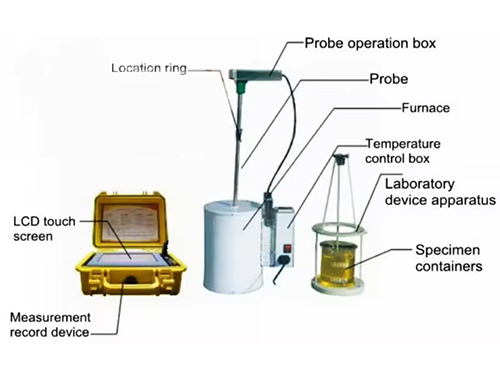
The KHR-A quenchometer, manufactured by Zhengzhou Kehui Technology Co., Ltd., is designed for evaluating quenching medium cooling characteristics through cooling curve measurement and analysis.
According to Kehui’s engineering team, KHR-A supports testing related to ASTM D6200 and ISO 9950. It helps users measure cooling curves and compare the cooling behavior of different oil samples or samples collected at different stages of service.
Founded in 1994, Kehui has experience in developing and manufacturing industrial equipment and provides overseas technical support, including equipment operation guidance and application assistance.
For heat treatment laboratories and manufacturers looking for quenching oil testing equipment, KHR-A offers a practical option for standardized cooling characteristic evaluation.
Testing frequency depends on production volume, oil type, operating conditions, and quality requirements. Manufacturers should establish a regular testing schedule and perform additional checks when process conditions or oil performance change.
Compare cooling curves from different testing periods under consistent conditions. Significant changes may indicate differences in cooling behavior and should be investigated.
It shows how the temperature of a standardized probe changes over time during cooling. The curve and calculated cooling rate help evaluate the cooling characteristics of the oil.
A quenchometer can identify changes in cooling characteristics, but it cannot independently determine the chemical causes of oil degradation. Additional oil analysis may be required.
No. It complements other tests, such as viscosity, water content, and chemical condition analysis, by providing information about cooling performance.
Regular quenching oil performance monitoring helps industrial heat treatment manufacturers identify changes in cooling behavior and maintain more consistent process conditions.
Cooling curve testing provides measurable data for evaluating quenching oil, comparing samples, and supporting heat treatment quality control. The KHR-A quenchometer from Kehui offers a solution for laboratories and manufacturers that need to evaluate quenching medium cooling characteristics through standardized testing.
 TAG:
We value your message!
Please fill the below, We will customized the solution to your needs.