Stock Code: 831045
Industrial Automation & Intelligence Solutions
SUMMERY: A forged shaft comes out of the quench with a hardness reading that looks acceptable on the surface, but the core is soft—or a batch of large-section forgings cracks after a quenchant change that “looked fine on the certificate.” The har...
A forged shaft comes out of the quench with a hardness reading that looks acceptable on the surface, but the core is soft—or a batch of large-section forgings cracks after a quenchant change that “looked fine on the certificate.” The hardness check confirms the failure; it does not explain it, and it certainly does not predict it. The missing evidence is the cooling curve—the one record that shows whether the quenchant actually delivered the cooling pathway the forging required.
Forging is not a passive downstream user of forging heat treatment equipment. The combination of large cross-sections, narrow quenching windows in forging direct quenching, and a wide range of steel grades makes the quenchant’s cooling behavior a first-order process variable. A quenchometer—a cooling curve tester built to measure the medium rather than the part—is the instrument that makes that variable visible.
A machined part is usually quenched after a separate austenitizing cycle, with a known and uniform starting temperature. A forging often arrives at the quench with a temperature distribution inherited from the forging operation—surface and core are not at the same temperature, and the effective section can be large enough that the core cools far more slowly than the surface. The consequence is a cooling requirement split across two temperature regions.
In the high-temperature region, the cooling rate must be fast enough to avoid ferrite and pearlite formation in the core of a large section. In the low-temperature region, the cooling rate through the martensite transformation must be controlled, because the thermal gradient in a large forging is already high, and a low-temperature rate that is too fast adds transformation stress on top of it. The literature on forging quenchants states the trade-off directly: a cooling rate high enough to achieve deep hardening “will increase the temperature difference across the section, increase thermal and transformation stress, and easily cause distortion and cracking.”
A hardness check after the fact cannot separate these two regions. A quenchometer, by recording the cooling curve and reporting the maximum cooling rate, the 300°C cooling rate, and the characteristic temperatures, gives the forging shop the two-region information that a single hardness number collapses.
Forging direct quenching—quenching immediately after forging using the residual heat—is widely used because it saves a reheat cycle and can improve properties. It also removes most of the tolerance in the process. The forging temperature itself has to be controlled within a narrow band; the quenchant has to cool the part through the required transformation before the residual heat is lost in the wrong temperature range.
The forging literature is specific about the consequence. In a study of 42CrMo heavy front axles (120–140 kg) produced by direct quenching, the authors conclude that the most important controls in forging quenching are the quenching temperature and the quenchant, and that the quenchant’s cooling capacity must be strong enough to achieve hardening without being so severe that it produces cracking. The same study identifies the 300°C cooling rate as the operative parameter for the PAG quenchant used, with a recommended V₃₀₀ of roughly 50–60°C/s.
This is where a quenchometer changes the control logic. The quenchant’s 300°C cooling rate is not a constant. PAG concentration drifts, oil degrades, water contaminates, and agitation changes. A cooling curve tester that reports the 300°C rate against a stored baseline tells the forging shop whether the medium is still inside the window qualified for that forging, rather than relying on a certificate or a visual check.
| Criterion | Forging direct quenching | Conventional re-austenitizing quench |
|---|---|---|
| Starting temperature | Inherited from forging; narrow window, core/surface not equal | Set by the austenitizing furnace; more uniform |
| High-temperature region | Must cool fast enough before residual heat is lost in the wrong range | Must cool fast enough to avoid ferrite/pearlite in the core |
| Low-temperature region | Must be controlled; section gradient already high | Must be controlled to limit transformation stress |
| Dominant medium parameter | 300°C cooling rate | Full curve shape, including vapor stage and 300°C rate |
| Baseline reference | Qualified-forging baseline per forging family | New-medium baseline per quenchant family |
| Typical failure if the medium drifts | Soft core or cracking in a narrow window | Hardness shortfall or cracking after a medium change |
Read the table by the process you run. A shop running both direct quenching and conventional re-austenitizing needs two baseline sets, because the same medium can be inside the window for one process and outside it for the other.
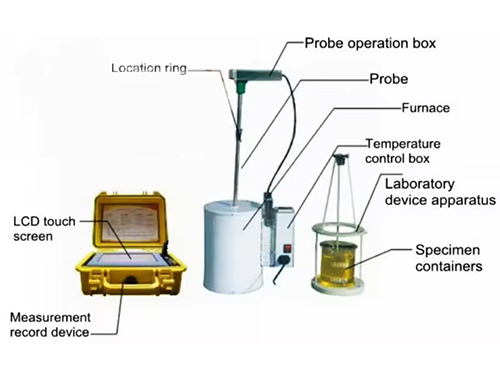
Role one: quenchant acceptance and batch consistency. A forging shop receiving a new PAG charge or a new oil delivery has no way to know from the label alone whether the medium will deliver the cooling behavior the forging was qualified on. A quenchometer run on the new charge, compared against the baseline curve for that medium family and that forging family, turns “the supplier says it is the same” into a measured acceptance criterion.
Role two: forging direct quenching window verification. Because the direct-quenching window is narrow, the medium’s 300°C cooling rate determines whether the forging lands inside the window or outside it. A quenchometer that reports this rate at the tank, against the qualified baseline, makes the window a measurable condition rather than an assumed one.
Role three: hardness shortfall and cracking investigation. When a forging shows low hardness or cracking after quenching, the investigation has to separate heating-side causes (forging temperature, time-at-temperature, grade) from cooling-side causes (medium condition, agitation, section size). The cooling curve provides the cooling-side evidence: has the maximum cooling rate moved, has the 300°C rate moved, has the vapor blanket stage changed shape. Without that evidence, the investigation defaults to “replace the oil” or “change the agitation” without knowing which variable actually moved.
A quenchometer only creates decision value when the curve is compared against a baseline for the same medium and the same forging family. For a forging operation, the useful baseline set is:
New-medium baseline for each quenchant family used, recorded at the concentration or condition specified by the supplier.
Qualified-forging baseline, recorded when a forging family first passes metallurgical qualification, so that later curves can be judged against the condition that produced acceptable hardness and microstructure.
Post-change baseline, recorded immediately after a medium change, concentration adjustment, or agitation modification, so that the next routine measurement is compared against the new state rather than a historical curve that no longer applies.
A quenchometer with result storage and curve overlay supports exactly this practice: the current curve sits on top of the relevant baseline, and the shift is visible. Platforms such as IVF SmartQuench established the expectation that a cooling curve record should be comparable across measurements rather than a one-off snapshot, and the KHR-A carries that expectation into tank-side use. A cooling curve tester that reports only an isolated maximum rate cannot support this comparison.
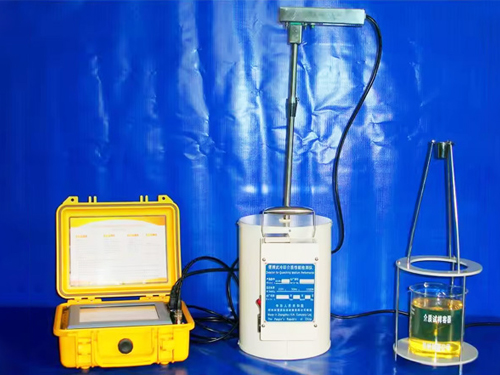
The KHR-A Quenchometer is manufactured by Zhengzhou Kehui Technology (Kehui Group), founded in 1994. Kehui’s founder is a technical specialist in this field, and the company was the first domestic Chinese manufacturer to independently develop and manufacture quenching medium cooling performance testers. The KHR-A carries patent ZL 2008 2 0069148.0 and is designed for oil, polymer, water-based, salt, and gas quenching media. Kehui’s quenching detectors have covered approximately 95% of the Chinese domestic market, with an installed base spanning chemical, boiler, pressure vessel, engineering machinery, military, and nuclear power applications. Its quenchometer is listed among equipment for heat treatment forging quenching oils and water performance testing, measuring cooling speed directly with an Inconel 600 probe to judge the cooling performance of the medium.
For a forging heat treatment operation, the relevant claim is narrow: the KHR-A is a quenchometer that records the cooling curve at the tank, reports the maximum cooling rate, 300°C cooling rate, characteristic temperatures, and time-to-temperature, and stores results for baseline overlay. It does not replace hardness testing, metallography, or forging temperature control. It supplies the medium-side measurement that those checks cannot provide.
Does a forging shop need a quenchometer, or is hardness testing enough?
Hardness testing confirms whether a forging met the specification; it does not explain why it failed or predict whether the next lot will fail. A quenchometer measures the medium’s cooling curve, which determines whether a large section hardens through and whether the low-temperature rate stays below the cracking threshold.
What is the most important cooling curve parameter for forging direct quenching?
For the PAG medium used in a documented 42CrMo direct-quenching application, the 300°C cooling rate is identified as the key parameter, with a recommended range of roughly 50–60°C/s. The specific target depends on the forging family and the qualified baseline; the quenchometer’s role is to measure it against that baseline.
Can a quenchometer predict cracking in a large forging?
It cannot predict the crack itself, but it can show whether the medium’s low-temperature cooling rate has moved above the rate qualified as crack-safe for that forging. That is the cooling-side evidence a cracking investigation needs.
Which forging steels are most sensitive to quenchant cooling rate?
Sensitivity is highest where hardenability and section size interact: 40Cr and 45 steel are commonly quenched in water or polymer and are sensitive to low-temperature rate because of cracking risk; 35CrMo and 42CrMo are typically oil- or PAG-quenched and are sensitive to the 300°C cooling rate for the same reason; 20CrMnTi gear forgings are usually carburized before quenching, so the cooling curve has to satisfy a case-and-core requirement rather than a through-hardening one. The quenchometer does not change the material’s sensitivity—it makes the medium’s contribution to it measurable.
How often should a forging operation test its quenchant?
CQI-9 4th Edition Section 3.14 requires every six months for in-use oil, covering water, suspended solids, total acid number, viscosity, flash point, and cooling curve; many auditing agencies and suppliers expect quarterly in practice. For forging direct quenching, where the window is narrow, a higher frequency—monthly or per medium change—is justified by the exposure.
Does the KHR-A Quenchometer replace a laboratory quench oil test?
No. It supplies the cooling curve measurement at the tank. Water content, acid value, viscosity, and flash point remain laboratory tests. The quenchometer makes the functional measurement frequent enough to cover the batches between laboratory samples. For shops already familiar with IVF SmartQuench-class curve records, the KHR-A provides the same comparison logic in a tank-side instrument.
A forging that passes hardness and metallography has proven that one part met the specification. It has not proven that the quenchant will deliver the same cooling pathway for the next large section, the next direct-quenched lot, or the next medium charge. The quenchometer is the instrument that records the medium side of that equation—the cooling curve against the forging family’s qualified baseline.
If you are running forging direct quenching or conventional forging quench operations and your only cooling-side record is a hardness check and a supplier certificate, send us the forging family, the quenchant type and concentration, and the hardness or cracking pattern you are seeing. We will tell you what the cooling curve should be compared against—not simply quote an instrument.
 TAG:
We value your message!
Please fill the below, We will customized the solution to your needs.